

Last Updated: November 4, 2026
Quick Summary
To compare ethical streetwear materials side by side, judge each fabric on three things: where the fiber comes from, how it is processed, and what happens at end of life. Then score the options against the job the garment must do, rather than against an abstract idea of what is best.
- Confirm the exact fiber percentages, since a small elastane blend changes how a fabric behaves and recycles.
- Match each certificate to the specific claim it supports and check its scope, because no single standard covers the whole chain.
- Choose cotton when softness and breathability matter, and recycled polyester when shape retention and weather resistance matter.
- Treat words like eco or conscious as intent rather than proof, and look for named standards or checkable sourcing details.
- Wash less often and in cold water, since washing method affects microfiber shedding as much as fiber choice does.
Table of Contents
- What Makes a Streetwear Material Ethical
- Comparing Fiber Options: Organic Cotton vs Recycled Polyester for Streetwear
- A Side-by-Side Method for Comparing Materials
- Textile Certification Standards for Apparel and What They Cover
- How to Identify Ethical Clothing Brands Beyond the Label
- Applying the Comparison to NewCity Brand's Current Range
- Choosing Your Next Piece With Confidence
- Frequently Asked Questions
What Makes a Streetwear Material Ethical
Ethical streetwear materials are judged on three things: where the fiber comes from, how it is processed, and what happens to the garment at the end of its life. At NewCity Brand, we build our pieces around that three-part test, and it is the lens this guide uses for every comparison that follows. For the wider technical picture, see what makes high-quality streetwear.
The fiber itself is only the starting point. Organic cotton, for example, describes how the crop was grown, while dyeing, finishing and washing can carry a much heavier environmental load. Ask whether a claim covers the whole chain or only one step.
Be wary of vague language. Words like "eco" or "conscious" describe intent, not verified practice. Look for specific, checkable statements about fiber content, origin and processing.
Comparing Fiber Options: Organic Cotton vs Recycled Polyester for Streetwear
Organic cotton and recycled polyester are the two fibers streetwear buyers encounter most often, and they solve different problems. Organic cotton is a natural fiber with a familiar hand feel, breathability and a traditional heavyweight drape. Recycled polyester is a synthetic fiber made from post-consumer or post-industrial material, which gives it strong shape retention and a crisp, structured surface.
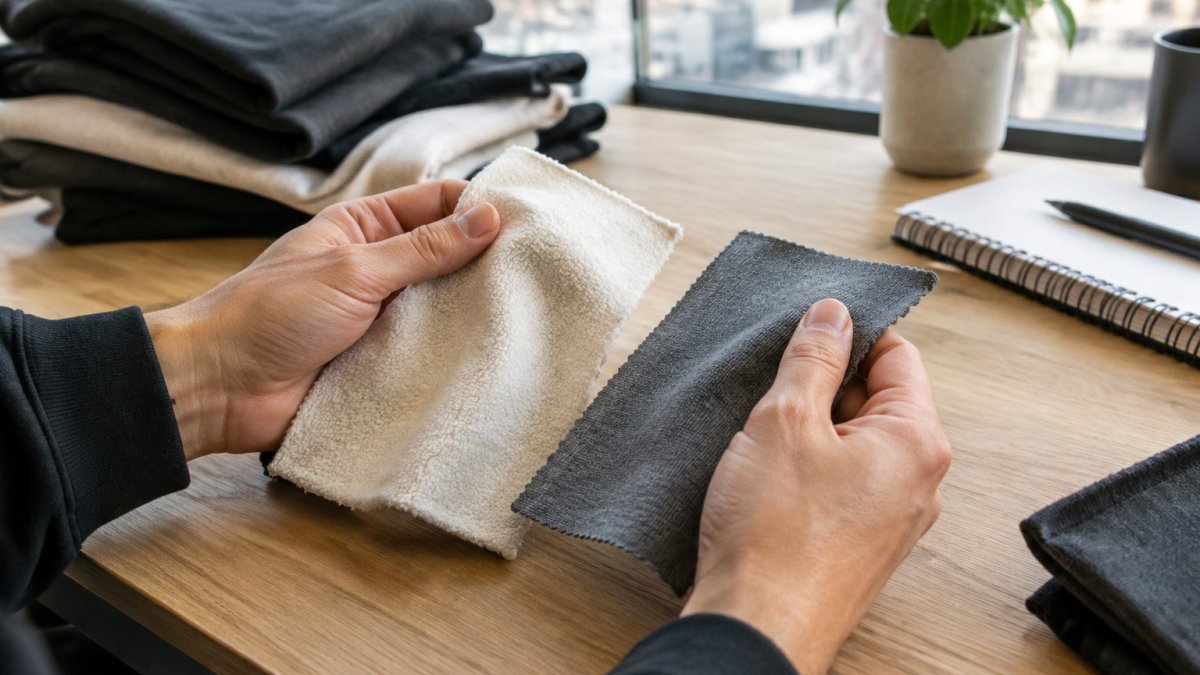
The choice comes down to what you need the garment to do.
Most buying guides stop at "natural versus synthetic," which hides the trade-offs that matter for streetwear: how each fiber wears, how it is cared for, and what happens to it after you stop wearing it.
| Dimension | Organic cotton | Recycled polyester |
|---|---|---|
| Raw material | Plant fiber grown without synthetic pesticides under organic certification | Synthetic fiber from post-consumer or post-industrial plastic |
| Hand feel | Soft, breathable, softens with washing | Smooth, crisp, can feel slick against skin |
| Shape retention | Moderate; can stretch at cuffs and necklines | High; resists sagging and bagging |
| Abrasion resistance | Moderate; pills with friction | High; resists pilling and scuffing |
| Breathability | High | Low to moderate; traps heat |
| Moisture behavior | Absorbs and holds moisture; slow to dry | Wicks and dries quickly |
| Color retention | Good, but fades with repeated washing | High; holds dye well |
| Microfiber shedding | Low | Notable during washing |
| End-of-life | Biodegradable; recyclable as a single fiber | Recyclable in principle, but plastic persists |
| Best streetwear use | Heavyweight tees, fleece hoodies, sweatpants | Outerwear, technical overshirts, structured layers |
Use the matrix as a starting point, not a verdict. If you are weighing a cotton piece in particular, our guide on whether heavy cotton hoodies are worth it covers the investment question.
Where Each Fiber Performs Well
Cotton performs best where comfort and breathability matter most: everyday tees, fleece-backed hoodies and relaxed sweatpants worn against the skin for hours.
Recycled polyester performs best where structure, water resistance and color retention matter: outerwear layers, technical overshirts and garments that see frequent washing without losing shape. It dries faster than cotton, which suits wet-weather wear.
A practical rule: if the piece is judged by how it feels and ages, look at cotton first.
Lifecycle Trade-Offs, Shedding and End-of-Life
Lifecycle is where the two fibers diverge most sharply. Cotton's footprint sits mainly in cultivation, water use and processing. Recycled polyester avoids virgin petroleum input, but it is still a plastic fiber, and it sheds microfibers during washing that enter wastewater.
Blended fabrics add a complication. A cotton-polyester blend can offer stretch and shape retention, but mixed fibers are harder to separate for recycling, so fiber-to-fiber recovery becomes difficult.
Plan for the garment's full life. For practical care instructions for snow washed cotton hoodies, see our dedicated guide.
Watch out: a "recycled" label does not tell you whether the garment is recyclable at end of life, and a "natural" label does not tell you how much water or pesticide went into growing it.
A Side-by-Side Method for Comparing Materials
Use this five-step method to compare any two streetwear materials on the same terms:
- Confirm the fiber content. Note the exact percentages, not just the fiber name. A "cotton" label with a 5 percent elastane blend behaves differently from 100 percent cotton.
- Check the origin and processing claims. Is the claim about growing, spinning, dyeing or finishing? Each stage needs its own evidence.
- Test the use case. Decide what the garment must do, then score each fabric against that requirement rather than against an abstract idea of "best."
- Weigh the lifecycle. Consider washing frequency, shedding and end-of-life options together.
- Compare the documentation. Prefer brands that state their material sourcing openly over those that rely on general sustainability language.
Record your scores in a simple grid. Keep the same criteria for every fabric so the comparison stays fair. The result will not give you a single winner, but it will show which material fits the job you actually have.
Snow‑Washed St. Louis “The Lou” Graphic Tee →
Textile Certification Standards for Apparel and What They Cover
Certifications are a useful shortcut, but each one covers something different, and none covers everything. Read the scope of a certificate before you treat it as proof of ethics. The table below compares the standards you are most likely to see on a streetwear label.
| Standard | What it verifies | What it does not verify | Typical streetwear use |
|---|---|---|---|
| GOTS (Global Organic Textile Standard) | Organic status of the fiber, processing restrictions, and certain social criteria along the supply chain | Full lifecycle impact, end-of-life recyclability | Organic cotton tees, hoodies, sweatpants |
| OEKO-TEX Standard 100 | Absence of harmful substances in the finished textile | Environmental impact of production, labor conditions | Any garment; a health and safety signal |
| Fair Trade Certified | Labor and wage conditions at certified facilities | Fiber origin, environmental processing | Cotton and blended apparel |
| GRS (Global Recycled Standard) | Recycled content share and chain of custody | Whether the garment itself is recyclable | Recycled polyester outerwear and blends |
| RCS (Recycled Claim Standard) | Recycled content share only | Processing, social, or environmental criteria | Lower-bar recycled-content claims |
| bluesign | Chemical and resource use in textile production | Fiber origin, labor conditions | Performance and technical fabrics |
| Cradle to Cradle Certified | Material health, circularity, and social fairness at multiple levels | Nothing about a specific garment's actual supply chain | Brands pursuing circular design |
Use the table as a scope map, not a ranking. A GOTS-certified organic cotton tee and a GRS-certified recycled polyester shell answer different questions, and neither certificate tells the whole story of the garment.
A Repeatable Label-Checking Process
When you pick up a garment or open a product page, run the same five checks every time:
- Read the fiber content first. Note exact percentages, not just the fiber name. A "cotton" label with 5 percent elastane behaves differently from 100 percent cotton, and the blend affects recyclability.
- Identify the certificate by name and number. A logo alone is not evidence. Look for the certificate number and the certifying body, then confirm the certificate is current on the certifier's public database.
- Match the certificate to the claim. If the brand says "organic," the certificate should cover organic fiber content. If it says "recycled," the certificate should cover recycled content. A certificate that covers a different stage of the chain does not support the claim.
- Check the scope. Ask whether the certificate covers the fiber, the processing, the finished textile, or the facility. GOTS covers fiber and processing; OEKO-TEX covers the finished textile; GRS covers recycled content. None of them covers the whole chain.
- Look for what is missing. A brand that shows one certificate but makes broad "sustainable" claims across its whole range is telling you the certificate applies to one product, not the line.
Record what you find in a simple note, fiber, certificate, number, scope, and what it does not cover. Over a few purchases, the pattern of what a brand documents becomes as informative as any single label.
Verified Claims vs Vague Terms
Some words on a label are defined and checkable; others are marketing. "Organic" and "recycled" have certification schemes behind them.
A practical test: if a claim cannot be tied to a named standard, a certificate number, or a specific, checkable statement about fiber origin and processing, treat it as unverified.
Watch out: a certificate that is current for one product line is often displayed across a brand's entire site.
How to Identify Ethical Clothing Brands Beyond the Label
A certification or a "sustainable" tag is a starting point, not a conclusion. To judge a brand properly, look for specifics: named fiber sources, stated production locations, a published supplier list or transparency report, and a clear returns or repair policy that supports longer garment life.
Be cautious of marketing that leans on a single eco feature to distract from the rest of the product. A recycled fiber in one component does not make the whole garment low-impact if construction, finishing and packaging tell a different story.
Applying the Comparison to NewCity Brand's Current Range
To see the method in practice, consider how NewCity Brand's current range fits the framework. Our Snow-Washed St. Louis "The Lou" Graphic Tee ($40.00) is 100% cotton with a 285g/m² fabric weight and a washed effect.
Our Women's Faux Fur Trim Full-Zip Hoodie ($55.00) uses a cotton-rich, polyester-blend construction.
Measure each piece against the same five steps before you buy, and check the fiber content on the listing rather than relying on the product name.
Choosing Your Next Piece With Confidence
Start with the job the garment has to do. If you want softness, breathability and a relaxed fade, a cotton piece is likely the better fit. If you need structure and weather resistance, a blend or recycled-polyester layer may serve you better, provided you accept its shedding and recycling limits.
Whichever you choose, read the fiber content, confirm what each certification actually covers, and favor brands that show their working.
Frequently Asked Questions
What makes a streetwear material considered ethical?
An ethical streetwear material is judged on several layers at once: the fiber itself (organic, recycled or natural), how it was grown or recovered, how the fabric was processed and dyed, and whether the workers who made it were paid fairly and worked in safe conditions. No single attribute settles the question. A recycled polyester can carry a lower footprint from fiber production yet still shed microfibers in the wash, while organic cotton reduces pesticide exposure in the field but can still be heavy in water use. Compare materials across these layers rather than trusting one headline claim.
Is recycled polyester better than organic cotton for streetwear?
It depends on the criteria. Recycled polyester keeps post-consumer textile waste out of landfill and avoids virgin petroleum feedstock, and it tends to hold shape and resist wear in heavy-use pieces. Organic cotton avoids synthetic fibers that shed microplastics and is more easily composted or recycled mechanically at end of life. For a boxy tee worn daily, organic cotton is often the more comfortable choice; for a heavy-use layer such as a hoodie or outer shell, recycled polyester can outlast it. Weigh garment use alongside the fiber.
What certifications should I look for in ethical streetwear?
Look for certifications that verify specific claims. The Global Organic Textile Standard (GOTS) covers organic fiber content and processing with social criteria. OEKO-TEX Standard 100 tests finished products for harmful substances. Fair Trade certification addresses wages and working conditions. Recycled claims are best supported by the Global Recycled Standard, which verifies recycled content. Each certificate covers a different thing, so a brand may hold one and not another. Check which claim each one supports before assuming a garment meets every standard.
How do I read garment labels to identify ethical sourcing?
Start with the fiber content line, which lists percentages such as 100% cotton or 80% cotton and 20% polyester, and note whether recycled content is stated. Then check the care label for washing guidance, since fabrics that need gentle care tend to last longer. Finally, look for certification marks and a country of origin. A label that names fibers and certifications is more verifiable than one that uses only general words like eco or conscious.
