

Last Updated: October 31, 2026
Quick Summary
Grassroots design reshapes modern trends by feeding the mainstream authentic signals from neighborhoods, local musicians, and independent makers, which designers then translate into commercial work. Social platforms now compress the distance between a local scene and a national trend from years to weeks, and buyers read community-rooted design as credible rather than borrowed.
- Top-down design optimizes for scale, while grassroots design optimizes for specificity.
- The participatory design process moves through listening, co-design, prototyping, and shared evaluation.
- Translation makes a grassroots idea scale, but it is also what dilutes it.
- A design failing two or more of the origin, consent, credit, and compensation questions is borrowing without reciprocity.
- Lock in community ownership early, before outside money arrives and pushes the original community aside.
Table of Contents
- Grassroots Design, Defined: From Local Knowledge to Global Aesthetic
- Grassroots Design Reshapes Modern Trends
- Grassroots Design Examples That Went Mainstream
- Inside the Participatory Design Process
- Grassroots Innovation: Where Community Energy Meets the Built Environment
- Cultural Appropriation vs. Cultural Appreciation in Design Borrowing
- Barriers to Scaling Community-Led Design
- Wear Your City: Building a Wardrobe Rooted in Local Identity
- Frequently Asked Questions
Grassroots Design, Defined: From Local Knowledge to Global Aesthetic
Grassroots design is the practice of shaping products, spaces, and visual culture from the bottom up, driven by the people who live with the outcome rather than by a brand committee or a distant design studio. The impact of grassroots design on modern trends shows up everywhere now, from streetwear graphics to neighborhood planning, because ideas that start with real communities carry authenticity that manufactured trends cannot fake. Below, we break down where grassroots design came from, how it moves into the mainstream, and where it goes wrong.
How Grassroots Design Differs From Top-Down Design
Top-down design starts with a brief and works toward a market. Grassroots design starts with local knowledge and works outward from a community. The distinction matters because the two produce different kinds of value: one optimizes for scale, the other for specificity. A top-down team asks what will sell broadly. A community-led design process asks what a place actually sounds, looks, and feels like.
Grassroots Design Reshapes Modern Trends
Community-led design reshapes modern trends by feeding the mainstream a steady stream of authentic signals. Designers watch what neighborhoods, local musicians, and independent makers are already doing, then translate those cues into commercial work. This is not new. What changed is speed. Social platforms compress the distance between a local scene and a national trend from years to weeks.
From Community Participation to Consumer Behavior
Consumer behavior follows the same path. When buyers see a design rooted in a real place, they read it as credible rather than borrowed. Many brands now build community participation into product development for exactly this reason: it produces designs people feel ownership over.
Grassroots Design Examples That Went Mainstream
Grassroots design examples appear in streetwear graphics tied to specific zip codes, in farmers markets that reshaped grocery retail, and in community land trusts that influenced how cities plan housing. Each started small and local. Each later became a reference point for larger brands and institutions. The pattern repeats: a community solves its own problem, the solution gets documented, and the wider market adopts the idea.
If you're tired of generic city souvenir shirts that say nothing about where you actually live, alternatives that express real local identity are worth a look.
Inside the Participatory Design Process
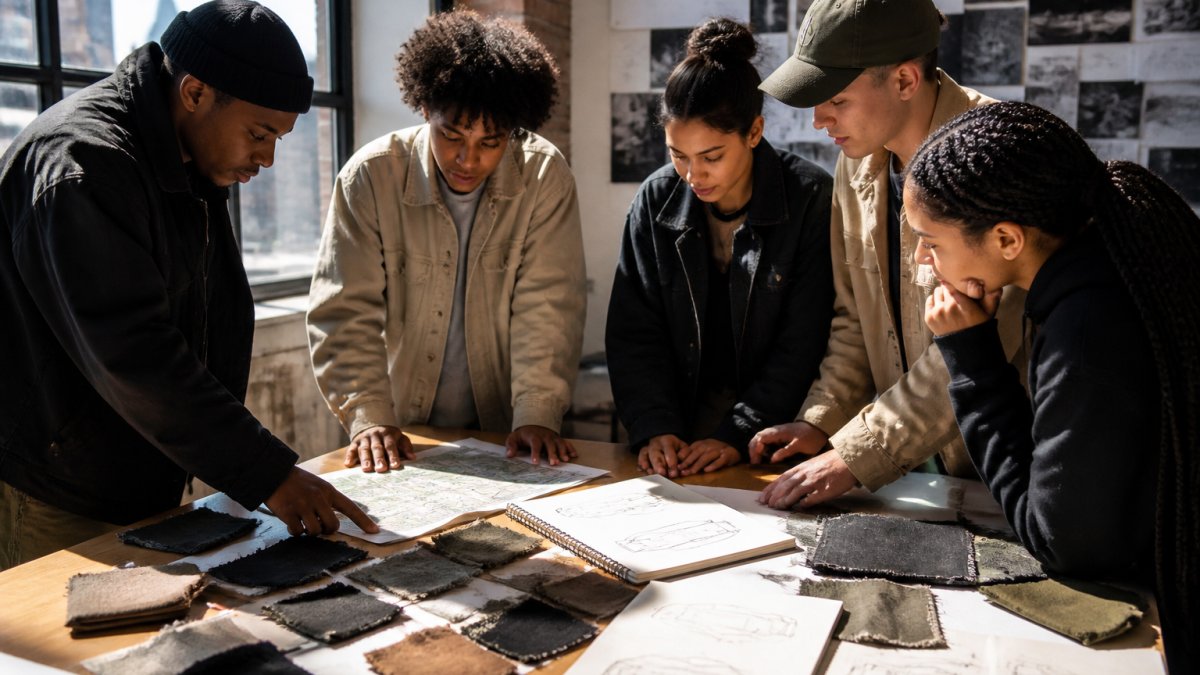
The participatory design process moves through four stages: listening, co-design, prototyping, and shared evaluation. Listening means gathering local knowledge before anyone sketches. Co-design brings residents into the work as collaborators, not focus group subjects. Prototyping tests ideas in public. Shared evaluation asks the community, not just the client, whether the result worked.
Co-Design Methods That Actually Work
The methods that hold up in practice are unglamorous:
- Community workshops with physical materials, not slide decks
- Walking audits where residents point out what outsiders miss
- Open studios that let people react to work in progress
- Paid community panels that compensate participants for their time
- Public review rounds with a documented response to feedback
A common mistake is treating co-design as a single meeting. Real participation runs across the whole project.
The participatory design process moves through four stages, each with a distinct job.
| Stage | What it means |
|---|---|
| Listening | Gathering local knowledge before anyone sketches |
| Co-design | Bringing residents in as collaborators, not focus group subjects |
| Prototyping | Testing ideas in public |
| Shared evaluation | Asking the community, not just the client, whether it worked |
Grassroots Innovation: Where Community Energy Meets the Built Environment
Grassroots innovation in the built environment shows up in community energy projects, cohousing developments, urban gardens, and resident-led redesigns of public space. These efforts connect local knowledge to architecture and landscape design decisions that professionals then help realize. The result is a built environment that reflects how people actually use space rather than how a planner assumed they would.
What the trend coverage usually skips is the translation step, the mechanism by which a resident-led experiment becomes a mainstream design move. A common pattern runs in four stages:
- Local problem, local fix. Residents solve a specific problem with materials and labor they control, a shared courtyard, a tool library, a block-level energy cooperative.
- Documentation. The fix gets photographed, measured, and written up, often by a nonprofit or a university partner, so it becomes legible to outsiders.
- Professional translation. Architects, landscape designers, and developers adapt the idea into code-compliant, financeable form, which usually means simplifying it.
- Mainstream adoption. The adapted version appears in commercial developments and municipal standards, often stripped of the community that originated it.
The trade-off is real: translation is what makes a grassroots idea scale, and translation is also what dilutes it. Designers who want the trend without the erasure have to keep the origin community involved beyond the first stage.
Concrete examples of the pattern are easy to find once you know what to look for. Community land trusts, resident-governed nonprofits that hold land on behalf of a neighborhood, are one example of a community-developed model that has spread into wider housing discussions. In general, resident-led efforts often begin with a single block or park and can influence later public design conversations, and community gardens and urban farms have grown from informal food access projects into more widely recognized neighborhood amenities.
Black Raw Seam Paneled St. Louis 314 Boxy Tee →
For a deeper look at brands building city identity into their products, see our guide to streetwear brands that center city identity.
Cultural Appropriation vs. Cultural Appreciation in Design Borrowing
Design borrowing becomes appropriation when a brand takes a community's visual language without credit, payment, or participation. It stays appreciation when the origin is named, the makers benefit, and the community has a say. The line is not about who designed it. It is about who profits and who gets erased. Many designers now build attribution and revenue-sharing into their process to keep that line clear.
Most competitors stop there. The useful version of this section is a working test a designer can actually apply, because "appreciation vs. appropriation" is otherwise a slogan. A common pattern among practitioners is to run four questions before a community-derived motif goes into production:
- Origin: Can you name the specific community, region, or tradition the motif comes from, not a continent, a country?
- Consent: Did anyone from that community review the design before it shipped, and did they have the ability to say no?
- Credit: Is the source named in the product copy, the campaign, and the contract, not buried in a mood board?
- Compensation: Does money or ownership flow back to the origin community, or does the brand capture all of the upside?
A design that fails two or more of those questions is borrowing without reciprocity, regardless of how the brand describes it. A design that passes all four is appreciation in the sense that matters commercially and ethically.
The mechanism that keeps brands honest is contractual, not sentimental. Attribution clauses, revenue-share agreements, and community review windows written into the design brief survive staff turnover and quarterly pressure; goodwill does not.
Power and ownership are the part the SERP misses. The question is not only whether a community was consulted but whether it retains agency after the trend takes off, whether it can license the motif, refuse a use, or share in the revenue. Designers who build that agency in early avoid the reputational and legal exposure that follows when a community publicly objects to a design it never approved.
Readers weighing this distinction can find ethical streetwear brands worth supporting that handle borrowing with more care.
Barriers to Scaling Community-Led Design
Scaling breaks community-led design in predictable ways. Participation gets expensive as projects grow. Decision-making slows when every voice needs a response. And success often attracts outside capital that pushes the original community aside. The barrier is often structural: ownership, funding, and who holds final say once an idea proves it can sell.
The practical answer is to lock in community ownership early, before the money arrives. If you want to know how to support independent local designers directly, that is where use actually exists.
Wear Your City: Building a Wardrobe Rooted in Local Identity
A wardrobe rooted in local identity starts with pieces that name a real place and mean it. Our Raw Seam Boxy Tee, The Lou 314 carries a 314 graphic on 100% cotton with raw exposed shoulder seams and a boxy, loose fit, built for people who rep their city with intention. It is the same principle behind everything we make at NewCity Brand: local identity and premium construction.

Frequently Asked Questions
What is grassroots design?
Grassroots design is a design approach where the people who live in a place, not outside consultants or brands, drive the decisions. Residents, local artists, and community groups identify what they need and shape the outcome together. Think community gardens built on vacant lots, neighborhood murals, or city-specific apparel graphics drawn by people from that city. The defining feature is authorship: the community leads, and designers support. That distinction separates grassroots design from top-down design, where a single authority sets the brief and residents are consulted only after key choices are made.
How does grassroots design influence modern trends?
Community-led ideas enter the mainstream in stages. A local style gains visibility through community participation and social media, brands notice demand, and the look spreads into wider markets. Sneaker culture, streetwear graphics, and the current appetite for city-specific apparel all started in specific communities before becoming mass trends. The influence runs both ways: modern design trends also feed back into local scenes, which adapt and remix them. Brands that borrow without credit risk backlash, while those that collaborate with local creators build trust and more durable products.
What are examples of grassroots design?
Look for projects where residents held decision power. Community gardens on reclaimed urban land, resident-designed playgrounds, neighborhood-run markets, and locally drawn city graphics on apparel all qualify. Cohousing developments are another strong case: future residents often help plan shared spaces and flexible layouts before construction. The common thread is local knowledge shaping the final result. When you see a design that reflects a specific block, city, or scene rather than a generic aesthetic, there is a good chance a community-led process produced it.
How can brands incorporate grassroots ideas authentically?
Start by paying and crediting local creators instead of copying their work. Use a participatory design process: bring residents into early concept meetings, test samples with them, and give them real veto power on details that affect their community. Name the collaborators publicly. Avoid dropping a city name onto a generic product; the design should reflect something true about that place. Authentic brands also show up locally over time, not just during a launch. That consistency is what separates cultural appreciation from extraction, and customers notice the difference quickly.
The gap between a community's own design language and what the market offers is where most brands fail. We built NewCity Brand to close it, with minimalist designs, gritty modern aesthetics, high-grade fabrics, and city-specific graphics that treat local identity as the point rather than a marketing angle. Get started with NewCity Brand and wear a city that actually means something.
