

Last Updated: November 5, 2026
Quick Summary
Functional fashion for urban commuters means clothing engineered around movement, weather, and changing environments, not just looks. Build a small capsule around your dominant travel mode, prioritizing breathable layers, articulated cuts, secure pockets, and cushioned shoes with grippy soles. Choose one outer layer rated for your worst commute day rather than your best.
- The average city commuter changes environments four or more times a day, so cut for the sequence first.
- Cap your commuter capsule at three bottoms and two pairs of shoes that all mix together.
- A full-zip front is worth the slight weight penalty because it turns a hoodie into temperature control.
- Wash commuter clothing cold and inside out, then hang dry to prevent shrinking and fading.
- Check taped seams, not just fabric claims, since stitching lets water through in sustained rain.
Table of Contents
- Why Functional Fashion Beats Fast Fashion for Daily Commutes
- Functional Clothing That Works as Hard as Your Commute
- How to Build a Commuter Capsule Wardrobe Around Your Travel Mode
- Technical Outerwear for Weather That Changes Between 8 AM and 6 PM
- Comfortable Shoes for Commuting: What to Look For and What to Skip
- Fabric Performance and Care: Breathable, Water-Resistant, and Built to Last
- Bags, Storage, and Safety Details That Complete the Commute
- Shop NewCity Brand Pieces Built for the Daily Grind
- Frequently Asked Questions
Why Functional Fashion Beats Fast Fashion for Daily Commutes
Functional fashion is clothing engineered around movement, weather, and the realities of getting from home to desk and back again.
The average city commuter changes environments four or more times a day: street, platform, train car, office, then the reverse.
Below, we'll show you how to build a commuter wardrobe that survives all of it, from breathable layers to shoes you can walk a mile in.
Functional Clothing That Works as Hard as Your Commute
Functional clothing is apparel designed so that mobility, breathability, and durability are built into the pattern rather than added as an afterthought. The difference shows up in how the garment moves with you, how it handles moisture, and how it holds up over a hundred wears.
Start with construction details, not marketing claims. Look for:
- Articulated cuts at the knee and elbow, so fabric follows the joint instead of pulling
- Gusseted seams in the crotch and underarm, which prevent blowouts on stairs and bikes
- Fabric weight stated in GSM, so you can compare pieces honestly (a 420g/m² cotton French terry holds shape far better than a thin 280g/m² knit)
A common mistake is buying for the look and hoping the function follows. Read the spec sheet the way you'd read a running shoe's spec sheet, then judge the style.
How to Build a Commuter Capsule Wardrobe Around Your Travel Mode
A commuter capsule wardrobe is a small set of mix-and-match pieces chosen for one primary travel mode, so every combination works without decision fatigue. Build it in five steps:
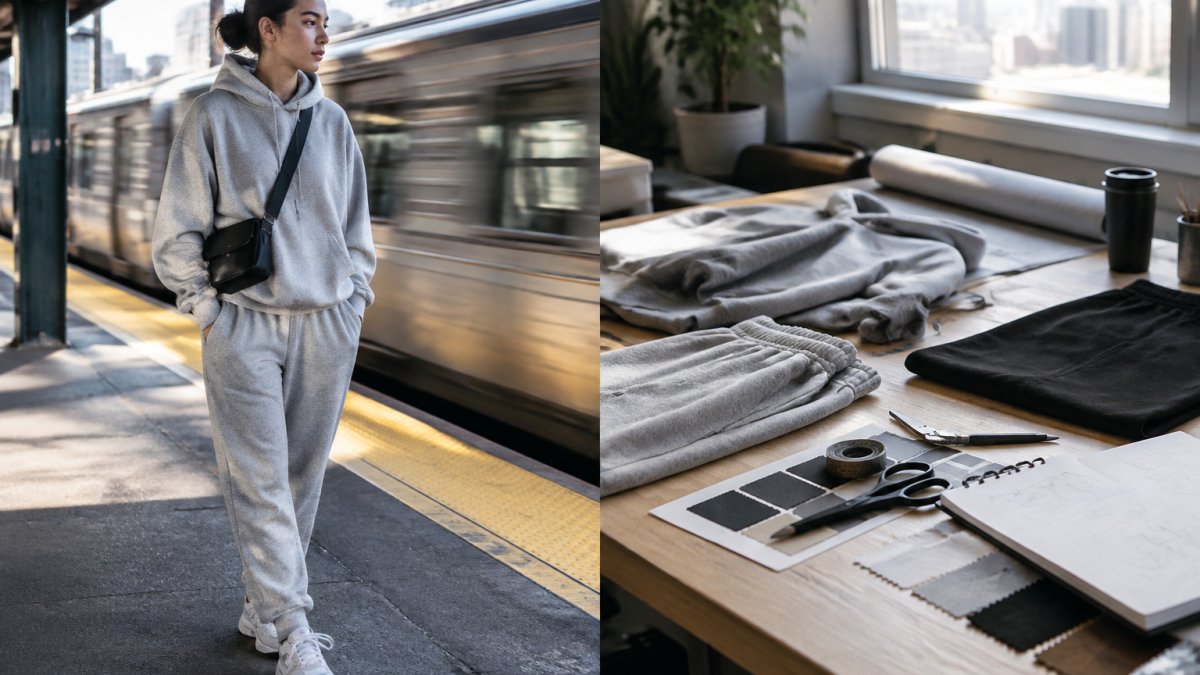
- Name your dominant mode. Walking, cycling, scooter, or public transit. Each one stresses different parts of an outfit.
- Pick your base layer for moisture. Breathable tees and lightweight knits for walking and transit; stretch-first fabrics for cycling.
- Add one mid layer with structure. A heavyweight hoodie or zip-front piece that holds a silhouette.
- Choose one outer layer rated for your worst commute day, not your best.
- Cap it at three bottoms and two pairs of shoes. If a piece doesn't mix with everything else, it doesn't belong.
That's the framework. The details change by mode, and the fastest way to apply them is to compare modes side by side.
Commute-Mode Comparison: Clothing, Footwear, and Carry Needs
Most style guides treat walking, cycling, scooters, and transit as separate topics. In practice, commuters often mix modes in a single trip, so the useful question is which requirements overlap and which conflict.
| Mode | Clothing priority | Footwear priority | Carry priority | Common failure point |
|---|---|---|---|---|
| Walking | Breathability and stretch through the hip and knee | Cushioned midsole, grippy outsole, structured heel | Crossbody or sling that stays tight to the body | Overheating on the walk, then freezing on arrival |
| Cycling | Articulated cuts, rear coverage, secure pockets | Stiff sole for pedaling, ankle clearance, reflective details | Backpack or messenger with a stable strap and weatherproof closure | Loose hems catching a chainring; phone sliding out of an open pocket |
| Scooter | Wind-resistant outer layer, secure closures | Flat, grippy sole with good board feel | Small sling or hip pack; nothing that swings | Cold wind at speed; bag straps flapping |
| Public transit | Easy on-off layers, wrinkle resistance | Slip-on or zip footwear for turnstiles and crowded doors | Structured tote or backpack with a padded laptop sleeve | Overheating in a crowded car; shoes that are slow to remove at security-style checkpoints |
Read the table as a set of trade-offs, not a ranking. A walking commuter who occasionally cycles should prioritize the walking column and add one cycling-specific fix, such as a zippered rear pocket or a cinching hem.
Walking and Public Transit: Breathable Layers and Easy-On Shoes
Walking and transit commutes often reward breathability and fast on-off.
Treat the walk as the heat-generating segment and the platform as the cooling segment.
Watch out: a heavy coat that feels right on a cold platform will leave you damp by the time you reach the office if the walk is more than a few blocks.
If you're planning a travel version of the same system, our guide on how to create a capsule wardrobe for travel walks through packing the same logic into a carry-on.
Cycling and Scooters: Articulated Cuts, Visibility, and Secure Pockets
Cycling and scooter commutes demand articulated cuts, secure pockets, and visibility. A phone that slides out of an open pocket at speed is gone.
For cycling, the rear of the garment matters as much as the front: a longer back hem keeps spray off your lower back, and reflective detail at the ankle or heel helps drivers notice you earlier.
For layering through cold rides, our breakdown of how to layer techwear for cold climates covers the base-mid-shell sequence in detail.
Technical Outerwear for Weather That Changes Between 8 AM and 6 PM
Technical outerwear decides whether a commute is miserable or merely wet. The test: can one jacket handle a cool, dry morning and a rainy, warmer evening without a second bag?
Three things matter more than brand names:
- Water resistance versus waterproofing. Water-resistant clothing sheds light rain and breathes better. Fully waterproof shells keep out sustained rain but trap heat.
- Packability. A shell you'll actually carry is better than a heavier one you leave at home.
- Ventilation. Pit zips or a full front zip let you dump heat fast when the train car is warm.
One insider note: a full-zip front is worth the slight weight penalty. It turns a hoodie into a temperature control device.
Weather-Specific Outfit Planning: Rain, Heat, Cold, and Wind
No jacket is optimal in every condition, so plan around the weather you're most likely to meet.
Casual Sportswear Set — ST. LOU 314 →
Rain. Prioritize a water-resistant or waterproof shell with taped seams and a hood that stays up in wind.
Heat. Breathability and moisture management beat waterproofing.
Wind. Wind resistance dominates, especially for scooter and cycling commutes.
Watch out: a jacket marketed as waterproof but without taped seams will still let water through the stitching in sustained rain.
For a deeper look at how fabric weight and fiber choice affect performance in each of these scenarios, see our guide to the best quality fabrics for urban apparel.
Comfortable Shoes for Commuting: What to Look For and What to Skip
Comfortable commuting shoes are defined by cushioning underfoot, a stable heel, and a sole that grips wet pavement. Style comes second, a commute is thousands of steps, not a photo shoot.
What to look for:
- A cushioned midsole with enough stack to absorb pavement impact
- A rubber outsole with visible tread, not a smooth fashion sole
- A structured heel counter that stops the shoe collapsing as you walk
What to skip: stiff leather soles, thin canvas flats, and any sneaker with a sole so flat you can feel every paving slab. Those are desk shoes. Keep a pair at work if you need them.
Fabric Performance and Care: Breathable, Water-Resistant, and Built to Last
Fabric performance and care determine whether a piece lasts a season or five years. The two biggest killers of commuter clothing are heat and agitation, and both are avoidable.
- Wash cold, inside out, on a gentle cycle. Hot water and friction break down cotton fibers and fade reactive dyes.
- Hang dry. Tumble drying at high heat shrinks cotton and weakens elastic cuffs.
- Wash with like colors. Dark dyes transfer onto lighter garments in the drum.
- Skip bleach and fabric softener. Both degrade performance finishes and cotton structure.
For a deeper look at GSM ratings and natural versus synthetic fibers, read our guide to the best quality fabrics for urban apparel.
Bags, Storage, and Safety Details That Complete the Commute
Bags and safety details are where a commute outfit either works or falls apart.
Safety matters more than most style guides admit. Reflective trim, a light-colored outer layer, and a small clip-on light make you visible on dark winter evenings.
To round out the kit, our guide to essential urban accessories for modern men covers the pieces that finish the look and the function.
Shop NewCity Brand Pieces Built for the Daily Grind
NewCity Brand builds pieces around heavyweight cotton and city identity. If you want one layer to build around, the Snow-Washed Zip Front Hoodie, St. Lou 314 at $68.00 is a strong pick: a 440g/m² cotton hoodie with a full-zip front, drop shoulders, and a snow-washed finish.
For a full set, the Casual Sportswear Set, ST. LOU 314 at $52.00 pairs a 420g/m² hoodie with heavyweight French terry sweatpants, pre-shrunk and reactive-dyed. The Women's STL Sportswear Set, 314 at $42.00 offers a relaxed fit, and the Brushed Fleece St. Lou 314 Sweatpants at $42.00 feature a crotch gusset and an oversized tapered fit.


Here's how the pieces compare:
| Piece | Weight | Key Commute Feature | Price |
|---|---|---|---|
| Snow-Washed Zip Front Hoodie | 440g/m² | Full-zip temperature control | $68.00 |
| Casual Sportswear Set | 420g/m² | Coordinated hoodie and sweatpants | $52.00 |
| Women's STL Sportswear Set | 420g/m² | Relaxed fit, easy movement | $42.00 |
| Brushed Fleece Sweatpants | 380g/m² | Crotch gusset, tapered fit | $42.00 |
Every piece is pre-shrunk and care instructions call for cold washing and drying flat or hanging.
Frequently Asked Questions
What is the 3-3-3 rule in fashion, and does it work for commuting?
The 3-3-3 rule is a styling shortcut: three colors, three textures, and three accessories per outfit. For commuting, it works best when you swap accessories for functional layers like a packable jacket, a crossbody bag, and a scarf. Keep the color palette tight so pieces mix across your commuter capsule wardrobe, and use texture (snow-washed cotton, brushed fleece, technical outerwear) to add visual interest without extra bulk. It is a guideline, not a law, so adjust it to your travel mode and weather.
What fabrics are best for comfortable commuter clothing?
Look for breathable cotton, French terry, and technical fabrics that wick moisture and dry quickly. Water-resistant clothing helps on wet mornings, while stretch and articulated cuts keep functional pants from fighting your stride. Avoid heavy non-breathable synthetics next to the skin on warm days. If you cycle or walk, choose fabrics with some give and reinforced stitching at high-stress seams. Care matters too: cold-water washing and hang drying keep breathable tees and stretch fabrics performing longer.
How do I build a commuter capsule wardrobe that works for walking and public transit?
Start with a small core of versatile wardrobe essentials: two pairs of functional pants, three breathable tees, one hoodie or zip-front layer, one technical outerwear piece, and comfortable shoes for commuting. Choose a consistent color palette so everything matches. Add a scarf and a crossbody bag for pocket placement and hands-free carrying. Test each piece on a full commute before committing. A commuter capsule wardrobe of 10 to 12 items can cover a full workweek and adapt to weather changes with layering.
What should I wear when my commute involves walking and public transit?
Prioritize breathable fabrics, a packable technical outerwear layer, and comfortable shoes for commuting with sturdy soles and secure laces. Wear functional clothing that moves with you, like joggers or stretch pants with utility details and pocket placement that keeps your phone and transit card reachable. Bring a scarf for changing temperatures on platforms and trains. In wet weather, water-resistant clothing and a bag with a sealed top protect work essentials. The goal is a polished appearance without sacrificing mobility.
Your commute is the hardest wear your wardrobe gets, and most closets are built for everything except that. Build around mobility, breathability, and construction you can verify, and the style follows. NewCity Brand makes heavyweight cotton pieces with taped seams, articulated fits, and snow-washed texture that hold up to daily use, so you can stop replacing fast fashion every season. Shop now and build a rotation that handles the walk, the platform, and the desk without a single compromise.
