

Table of Contents
- Natural vs. Synthetic Fibers for Best Quality Fabrics for Urban Apparel
- Heavyweight Cotton for Streetwear: Why GSM Decides Everything
- GSM Guide for Clothing Manufacturers and Streetwear Buyers
- Durability, Breathability, and Technical Performance in Urban Fabrics
- Sustainability, Colorfastness, and Fabric-to-Garment Matching
- How to Source Premium Apparel Fabrics for Urban Streetwear
- Best Quality Fabrics for Urban Apparel: Seasonal and Care Considerations
- Conclusion
Last Updated: August 16, 2026
The fabric under your hoodie is doing more work than most people realize. At NewCity Brand, we've spent years obsessing over what separates a piece that holds its shape, color, and character through hundreds of washes from one that pills, fades unevenly, and loses its silhouette after a season. The answer almost always comes back to fiber composition, GSM, and construction. This guide breaks down the best quality fabrics for urban apparel, covering everything from heavyweight cotton and GSM selection to sustainable sourcing and end-of-life circularity.

Natural vs. Synthetic Fibers for Best Quality Fabrics for Urban Apparel
The single biggest decision in urban apparel fabric selection is whether to build around natural or synthetic fibers.
Natural fibers like cotton, bamboo viscose, and Tencel dominate streetwear because they breathe, age with character, and respond well to wash treatments like snow-washing and sun-fading. Synthetic fibers like recycled polyester and nylon blends offer superior moisture-wicking and tensile strength, making them better suited for performance-oriented urban apparel.
Cotton, Bamboo Viscose, and Tencel: The Natural Tier
Cotton remains the backbone of streetwear. Its hand-feel is familiar, it accepts reactive dyes cleanly, and it holds up well to the distressing and wash treatments that define the urban aesthetic. Combed cotton, where short fibers are removed before spinning, produces a smoother, denser yarn that resists pilling and holds graphic prints with more precision.
Bamboo viscose has gained ground as an eco-conscious alternative. It's softer than standard cotton at comparable weights and offers natural moisture-wicking properties. Tencel (lyocell) is the strongest performer in the natural tier for drape and colorfastness, and its closed-loop production process makes it one of the more transparent supply chain options available to garment manufacturers.
The trade-off with all three is abrasion resistance. Natural fibers will wear through faster than synthetics under heavy daily use.
Recycled Polyester, Nylon Blends, and When Synthetics Make Sense
Recycled polyester has become the default choice for eco-conscious brands that need performance characteristics. It wicks moisture faster than cotton, dries quickly, and holds its shape under stress.
Nylon blends bring abrasion resistance that natural fibers cannot match. A cotton-nylon blend at the right ratio gives you the hand-feel of cotton with meaningfully better durability at stress points like pocket openings, cuffs, and hems.
The honest limitation of synthetics: they don't respond to wash treatments the same way. Snow-washed and sun-faded finishes that look authentic on cotton look flat on polyester. For streetwear that leads with texture and character, synthetics are a supporting player, not the lead.
Heavyweight Cotton for Streetwear: Why GSM Decides Everything
GSM, grams per square meter, is the single most important specification a streetwear buyer or manufacturer can learn to read. It determines drape, warmth, structure, and how well a garment holds up over time.
Most mass-market hoodies run between 280 and 320 GSM. For premium urban apparel, the floor starts at 380 GSM.
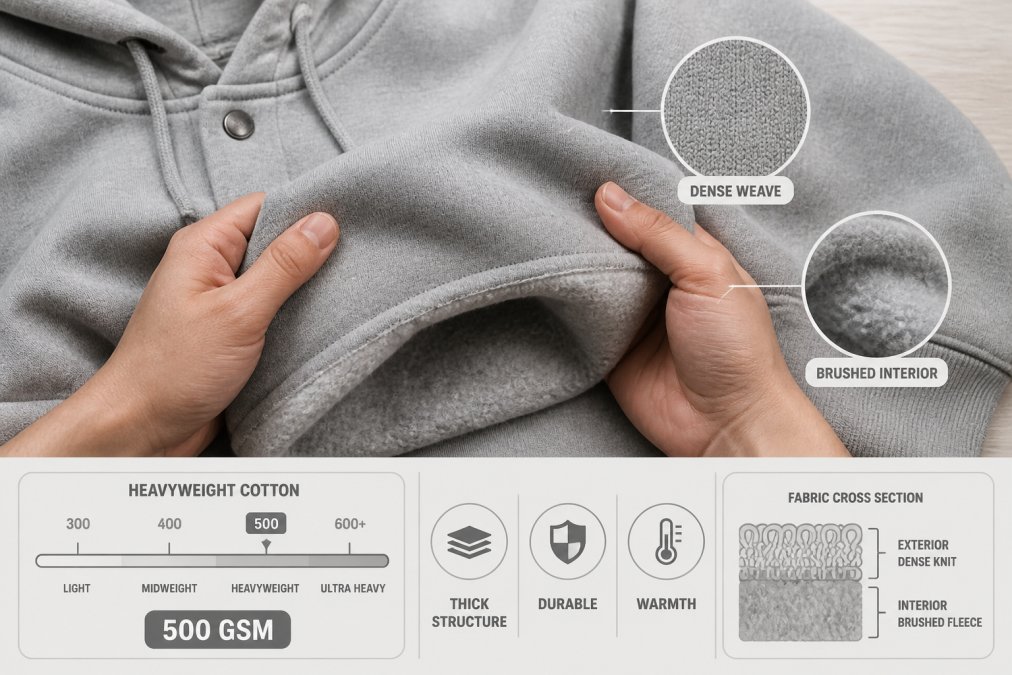
The NewCity Brand Brushed Fleece St. Lou 314 Hoodie is built at 380 GSM, 100% cotton with a brushed fleece interior that stays soft through repeated washes. The Heavyweight Sun-Faded Hoodie STL 314 steps up to 400 GSM, where heavyweight cotton starts to behave differently: it holds structure at the shoulders, resists bunching at the cuffs, and develops a richer fade pattern. The Snow-Washed New York Icon Zip Front Hoodie reaches 440 GSM, among the densest cotton constructions in the brand's lineup, with genuine thermal presence without synthetic fill.

Drape, Hand-Feel, and Silhouette by Fabric Weight
Drape and silhouette are where GSM choices become visible on the body. Lighter fabrics (under 300 GSM) tend to cling or collapse. Heavier fabrics hold their shape, which is why a 420 GSM French terry hoodie with drop shoulders maintains an oversized silhouette rather than folding inward.
Hand-feel is partly weight, partly yarn count. The Casual Sportswear Set ST. LOU 314 uses a 32-count plain weave at 420 GSM French terry; the higher yarn count produces a smoother surface even at heavy weight. A brushed fleece at 380 GSM will feel softer against skin than a tightly woven denim at 350 GSM. Construction and fiber finish matter as much as the number.
GSM Guide for Clothing Manufacturers and Streetwear Buyers
This GSM guide covers the practical weight ranges you'll encounter when speccing or shopping premium urban apparel.
| GSM Range | Fabric Type | Best For | Streetwear Application |
|---|---|---|---|
| 140-180 | Lightweight jersey | Summer tees, liners | Basic tees, underlayers |
| 220-260 | Mid-weight cotton | Everyday tees, light fleece | Graphic tees, casual tops |
| 280-300 | Standard fleece | Entry-level hoodies | Budget streetwear |
| 320-360 | Heavy jersey, loopback jersey | Premium tees, mid hoodies | Quality graphic tees |
| 380-420 | Heavyweight cotton, brushed fleece | Premium hoodies, sweatpants | Core streetwear staples |
| 420+ | French terry, dense fleece | Heavyweight sets, outerwear-adjacent | Top-tier urban apparel |
The Raw Seam Paneled Miami Boxy Tee and the Raw Seam Boxy Tee Phoenix 602 both run at 280 GSM, the right call for a tee that needs to drape loosely without adding bulk. The Snow-Washed St. Louis "The Lou" Graphic Tee sits at 285 GSM, which gives the snow-wash treatment enough fiber density to produce natural highs and lows without the fabric becoming translucent.

Durability, Breathability, and Technical Performance in Urban Fabrics
The best quality fabrics for urban apparel have to perform across wildly different conditions. Technical performance isn't optional; it's the baseline.
Abrasion Resistance and Tensile Strength in Daily Wear
Abrasion resistance measures how well a fabric holds up against repeated friction at cuffs, collar edges, and pocket openings. According to ASTM International's textile testing standards, standardized abrasion tests measure how many rub cycles a fabric withstands before showing wear.
Combed cotton at 380 GSM and above performs significantly better in abrasion testing than standard ring-spun cotton at lighter weights. The pre-shrunk treatment applied to NewCity Brand's cotton pieces also reduces the dimensional instability that causes seam stress, one of the most common failure points in cheaper streetwear.
Tensile strength, the force required to pull a fabric apart, is where cotton-nylon blends outperform pure cotton. For garments that see heavy physical use, a nylon blend at stress points is worth the trade-off in wash-treatment compatibility.
Moisture-Wicking and Thermal Regulation for City Climates
Pure cotton does not wick moisture the way synthetic fibers do. It absorbs sweat and holds it, which is why cotton-fleece blends and loopback jersey constructions became standard in premium streetwear. The loopback structure creates air pockets that improve thermal regulation without adding significant weight.
Bamboo viscose and Tencel both outperform cotton for moisture management at comparable weights. For urban apparel in humid climates, a bamboo viscose blend in the 220-260 GSM range is a practical choice for tees and lightweight layers.
Sustainability, Colorfastness, and Fabric-to-Garment Matching
Sustainability in urban apparel has moved past marketing language. Buyers increasingly expect fiber composition transparency, responsible dyeing processes, and honest end-of-life options.
Snow-Washed and Sun-Faded Finishes: Colorfastness Under Pressure
Snow-washed and sun-faded finishes are among the most technically demanding treatments in streetwear. The process intentionally breaks down some of the dye in the fabric to create a vintage, worn-in texture, which means colorfastness has to be engineered carefully so the fade looks intentional rather than just worn out.
Reactive dyeing, used across NewCity Brand's cotton pieces, bonds the dye molecule directly to the fiber at a chemical level. This produces significantly better colorfastness than pigment printing or direct dyeing, especially through repeated washing. The Snow-Washed Snap Collar Hoodie and the Snow-Washed New York Icon Zip Front Hoodie both note that slight color bleeding may occur in the first wash, which is a sign of an authentic wash treatment, not a defect. Always wash washed and faded pieces inside out, in cold water, with like-colored garments, and avoid direct sunlight during drying.
End-of-Life Circularity and Eco-Conscious Sourcing
End-of-life circularity is the angle most streetwear guides skip. A garment made from 100% cotton is, in principle, fully compostable or recyclable through textile recovery programs. Mixed-fiber garments are significantly harder to process at end of life because the fibers have to be separated before recycling.
For eco-conscious sourcing, look for suppliers who can provide Global Organic Textile Standard (GOTS) or OEKO-TEX certification on their cotton. These certifications cover both the fiber source and the dyeing and finishing processes, which is where most of the environmental impact in garment production occurs.
How to Source Premium Apparel Fabrics for Urban Streetwear
Sourcing premium apparel fabrics is where most emerging streetwear brands lose ground to established players. The gap isn't always budget, it's knowing what to ask for and how to verify what you're getting.
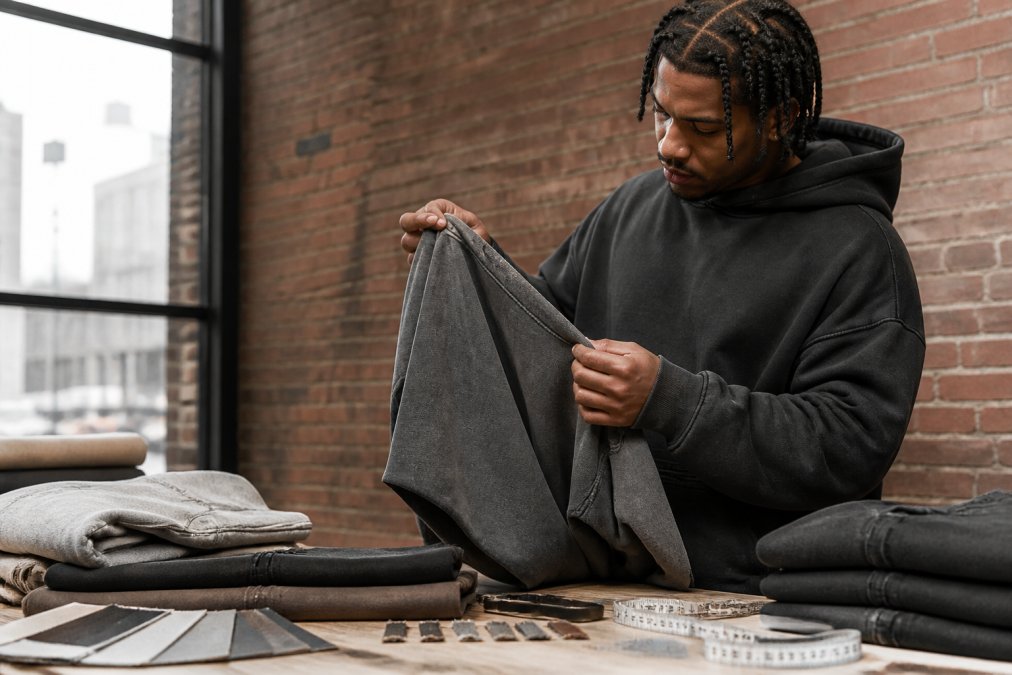
Start with GSM and fiber composition as non-negotiables. Any mill or supplier worth working with will provide a technical data sheet with these figures before you commit to a sample order.
Supply Chain Transparency: What to Ask Before You Buy
Supply chain transparency is the differentiator that separates brands with genuine quality claims from those with good photography. According to the Federal Trade Commission's guidance on textile labeling, garments sold in the US must accurately disclose fiber content, but that disclosure doesn't tell you where the fiber was grown, how it was processed, or what chemicals were used in finishing.
Here's what to ask before committing to a fabric supplier:
- What is the exact fiber composition and GSM of this fabric?
- Is the cotton ring-spun, open-end spun, or combed?
- What dyeing method is used, reactive, pigment, or direct?
- Do you hold GOTS, OEKO-TEX Standard 100, or equivalent certification?
- Can you provide a country-of-origin breakdown for the fiber, yarn, and fabric stages?
- What is the shrinkage rate after the first wash, and is the fabric pre-shrunk?
- What abrasion and colorfastness testing has been performed, and by what standard?
A supplier who can answer all of these questions with documentation is operating at a different level than one who can only tell you the price per yard. The documentation protects you legally, gives you accurate product descriptions for your customers, and makes it possible to make genuine sustainability claims.
Best Quality Fabrics for Urban Apparel: Seasonal and Care Considerations
The best quality fabrics for urban apparel don't perform the same way in July as they do in January, and care instructions are where most buyers leave performance on the table.
For summer wear, lightweight cotton in the 260-300 GSM range gives you the structure needed for graphic printing without trapping heat. The Raw Seam Boxy Tee Phoenix 602 at 280 GSM is a practical example: enough weight to hold the boxy silhouette, light enough for warm-weather wear.
For cold-weather pieces, 380 GSM and above is where the real utility begins. The French terry construction used in the Casual Sportswear Set ST. LOU 314 and the Women's STL Sportswear Set 314 (both at 420 GSM) provides thermal regulation through the looped interior structure.
Seasonal fabric suitability also affects how you care for pieces:
- Summer tees (260-300 GSM cotton): Cold wash, hang dry.
- Mid-weight fleece (320-360 GSM): Cold wash inside out. Low tumble dry is acceptable.
- Heavyweight cotton (380-440 GSM): Cold wash inside out, hang dry away from direct sunlight.
- Snow-washed and faded pieces: Always cold wash with like colors. Slight bleeding is normal in the first one to two washes.
The pre-shrunk treatment across NewCity Brand's cotton lineup addresses one of the most common complaints about premium cotton streetwear. According to AATCC textile care and testing standards, proper pre-shrinking can reduce post-wash dimensional change to under two percent, which is the threshold most quality streetwear brands target.
Urban apparel buyers face a real challenge: the market is full of pieces that look premium in product photos but don't hold up past a few washes. NewCity Brand addresses this directly through heavyweight cotton constructions ranging from 280 to 440 GSM, reactive dyeing for genuine colorfastness, and pre-shrunk treatments that keep silhouettes intact. Shop now at NewCity Brand and get streetwear that performs as well as it looks, from the first wear to the hundredth.
Frequently Asked Questions
What fabric weight is best for urban hoodies?
For heavyweight streetwear hoodies, 380-440 g/m² is the sweet spot. At that GSM range, the fabric holds a structured silhouette, resists pilling after repeated washes, and delivers the dense hand-feel associated with premium urban apparel. NewCity Brand's heavyweight hoodies sit between 380 g/m² and 440 g/m², giving each piece the substance to drape properly on oversized and boxy cuts without losing shape over time.
How do you identify high-quality fabric for streetwear?
Check three things: fiber composition, GSM, and construction details. High-quality urban apparel fabrics are typically 100% combed cotton or cotton-fleece blends at 280 g/m² or above. Look for reactive-dyed colorfastness, pre-shrunk treatment, and side-seamed construction. On finished garments, double-stitched ribbed cuffs and taped neck seams signal textile durability. Lightweight tees under 200 g/m² or fabrics without pre-shrunk treatment are signs of lower-grade sourcing.
Is organic cotton better for urban apparel than synthetic blends?
For most streetwear applications, organic cotton outperforms synthetic blends on breathability, hand-feel, and long-term comfort against the skin. It also supports eco-conscious sourcing goals. Synthetic blends like recycled polyester add moisture-wicking properties useful in performance contexts, but for everyday urban apparel where drape and texture matter most, heavyweight organic or combed cotton remains the preferred fiber. Cotton-fleece blends offer a middle ground, combining warmth with natural fiber comfort.
What is the difference between GSM and fabric quality?
GSM (grams per square meter) measures fabric weight, not quality outright. A 400 g/m² fabric is denser and heavier than a 200 g/m² fabric, but quality depends on fiber grade, yarn count, and finishing processes. Low-grade cotton at high GSM can still pill and shrink. True quality combines the right GSM for the garment type with combed or ring-spun cotton, reactive dyeing for colorfastness, and pre-shrunk treatment. For urban apparel, GSM is a useful starting filter, but fiber composition confirms the final call.
This article was written using GrandRanker