

Last Updated: October 24, 2026
Quick Summary
A capsule wardrobe travel collection is a curated set of versatile pieces that mix and match effortlessly while fitting into carry-on luggage, with every piece coordinating with at least three other items to eliminate decision fatigue and excess baggage.
- For a week-long trip, pack roughly 4 tops, 2 bottoms, 1 lightweight layer, 1 outerwear piece, and 2 shoes to create at least 12 distinct outfits.
- Choose 2-3 neutral colors as your base and add one accent color to ensure all pieces coordinate without clashing.
- Use the 5-4-3-2-1 packing method: 5 tops, 4 bottoms, 3 layers, 2 shoes, and 1 outerwear piece creates roughly 60 outfit combinations from 15 pieces.
- Verify your capsule with an outfit matrix before packing by laying out all tops and bottoms and confirming each combination works.
- Pack in cubes by category, wear bulkiest items in transit, and plan laundry access to extend your capsule across longer trips.
Table of Contents
- What Makes a Capsule Wardrobe for Travel Different
- Start with Your Travel Capsule Wardrobe Packing List
- Choose a Cohesive Color Palette and Versatile Pieces
- Building a Capsule Wardrobe for a Week-Long Trip
- Master the 5-4-3-2-1 Packing Method
- Pack Smart with a Carry-On Capsule Wardrobe
- Build Your Travel Capsule with Premium Basics
- Frequently Asked Questions
What Makes a Capsule Wardrobe for Travel Different
A capsule wardrobe travel collection is a curated set of versatile pieces that mix and match effortlessly while fitting into carry-on luggage.
The key difference is intentionality: every piece coordinates with at least three other items in your bag, eliminating decision fatigue and excess luggage.
Travel capsules also prioritize fabric quality and wrinkle resistance. Lightweight, easy-care materials survive cramped packing, multiple wears, and hand-washing in a hotel sink.
Start with Your Travel Capsule Wardrobe Packing List
Begin by assessing three factors: destination climate, trip length, and planned activities.
For a week-long trip, most people need:
- 3-4 tops (mix of casual and slightly dressier)
- 2 pairs of bottoms (usually jeans and one neutral pant or shorts)
- 1 lightweight layer (cardigan, sweater, or zip hoodie)
Write down your activities, museums, hiking, restaurants, meetings, and build your list backward from what you actually need.
The American Society of Travel Agents recommends matching your packing list to your specific itinerary rather than packing generically. This simple shift, packing for your actual trip instead of "travel in general", cuts unnecessary items by half.
Choose a Cohesive Color Palette and Versatile Pieces
Neutral colors, black, white, navy, gray, beige, cream, coordinate naturally and create endless combinations without clashing.
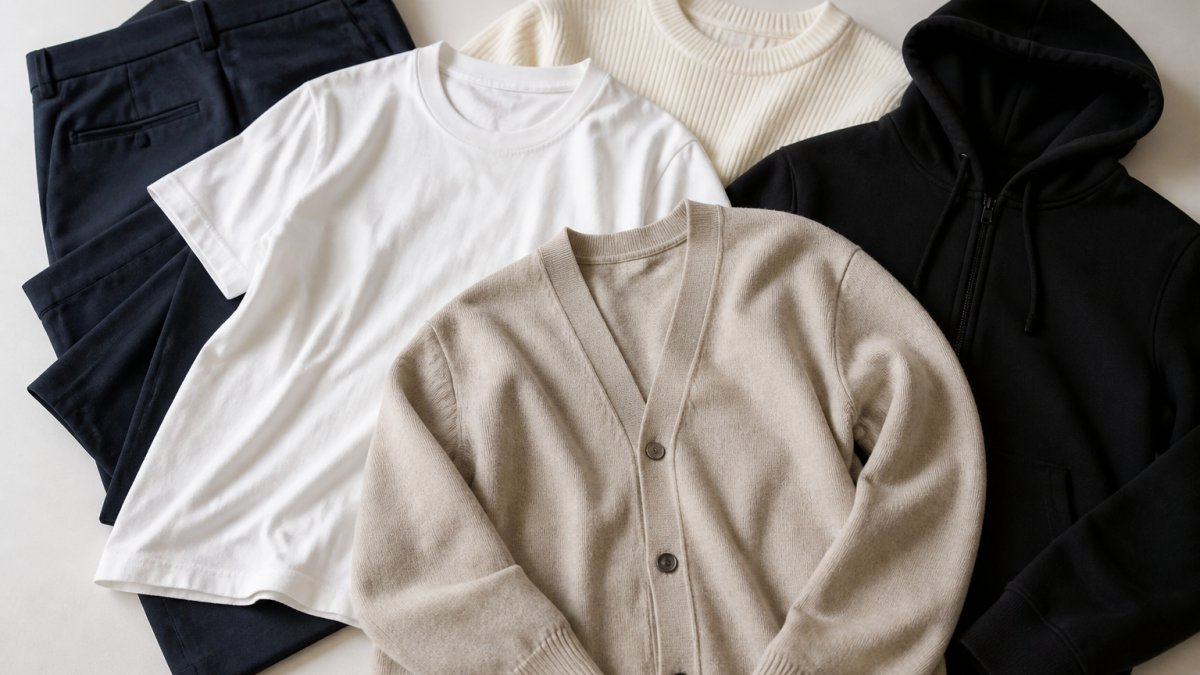
Pick 2-3 neutrals as your base: black and white means every top works with every bottom, and navy expands your options further. Neutral doesn't mean boring, NewCity Brand's minimalist designs with gritty modern aesthetics prove neutral pieces can feel bold and intentional.
Once your neutrals are locked, add one accent color, a single burgundy top or olive sweater can anchor multiple outfits without making your bag look chaotic.
Focus on versatile pieces:
- Classic crew neck t-shirts work for casual days and can be layered
- Neutral jeans pair with everything
- A solid sweater or lightweight hoodie layers over tees
The Fashion Institute of Technology's wardrobe design principles emphasizes that versatility comes from choosing pieces with clean lines and minimal pattern.
Avoid patterns, logos, and busy prints: a solid piece works with five other items, while a patterned piece works with maybe two.
Building a Capsule Wardrobe for a Week-Long Trip
A week-long trip is the sweet spot for capsule packing: enough days to justify variety, but not so many that you need a second bag.
Start with the trip-length math: count the days, subtract any laundry day, and add one backup outfit for delays.
| Item Type | Quantity | Role in the Capsule | Rewear Plan |
|---|---|---|---|
| Tops | 4 | Two casual tees, one slightly dressier top, one long-sleeve | Tees rewear once before laundry; dressier top wears twice |
| Bottoms | 2 | Jeans plus one neutral pant or short | Jeans rewear 3-4 times; neutral bottom 2 times |
| Lightweight layers | 1 | Cardigan, sweater, or zip hoodie | Rewear all week; air out nightly |
| Outerwear | 1 | Jacket or zip hoodie for weather and dressier looks | Wear in transit and on cool days |
| Undergarments | 7 | One per day | Hand-wash midweek or pack one extra set |
| Shoes | 2 | Walking shoe plus one dressier option | Alternate daily to let shoes dry |
| Accessories | 3-5 | Belt, scarf, hat, or jewelry | Swap to change outfit feel |
That is 18-20 pieces, and it should produce at least 12 distinct outfits. Do not take that number on faith.
Verify the capsule with an outfit matrix
Lay every top and bottom on your bed and build a grid: rows are tops, columns are bottoms. Mark each cell with an outfit you'd actually wear, four tops and two bottoms give eight base combinations, and the layer and outerwear multiply each one toward 20 or more. An empty cell means an orphan item; swap it for something that coordinates with at least three other pieces.
Adjust the formula by trip length and laundry access
The week-long list is a template, not a rule. Scale it with these adjustments:
- 3-day trip: 3 tops, 2 bottoms, 1 layer, 1 pair of shoes, 1 outerwear piece. Skip laundry planning entirely.
- 10-day trip with laundry access: 5 tops, 3 bottoms, 2 layers, 2 pairs of shoes. Plan one laundry session around day five.
- 10-day trip without laundry access: 7 tops, 3 bottoms, 2 layers, 2 pairs of shoes, and pack a travel detergent sheet for sink washing. Rewearing becomes a schedule, not an accident.
Build the day-by-day outfit plan
Before zipping the bag, write a one-week outfit plan: day, activity, outfit, shoes. If day four has no outfit you're happy to wear, fix the capsule now rather than at the hotel.
A Consumer Reports guide on travel wardrobe planning notes that travelers who plan outfits before packing tend to pack lighter than those who pack item by item. The mechanism is simple: planning forces combinations, and combinations expose duplicate pieces before they take up space.
Master the 5-4-3-2-1 Packing Method
The 5-4-3-2-1 packing method builds outfit variety from minimal pieces:
- 5 tops
- 4 bottoms
- 3 layers (sweaters, cardigans, lightweight jackets)
This creates roughly 60 outfit combinations from just 15 pieces, because each top pairs with each bottom and layers multiply options exponentially.
Classic Fit Crew Neck T‑Shirt — STL 314 →
Adjust the numbers based on your trip length and activities:
For a 3-day trip: 3 tops, 2 bottoms, 1 layer, 1 shoe, 1 outerwear For a 10-day trip: 6 tops, 5 bottoms, 3 layers, 2-3 shoes, 1-2 outerwear pieces
The principle stays the same: every piece works with multiple other pieces, no orphaned items.
Lay out your planned pieces before packing and build combinations on your bed or floor. Can you make five different outfits?
The Classic Fit Crew Neck T‑Shirt from NewCity Brand works perfectly in this method, it layers, it pairs with jeans or neutral pants, and it works for casual and slightly dressier occasions.
Pack Smart with a Carry-On Capsule Wardrobe
Carry-on constraints are the forcing function that makes a capsule wardrobe travel system work. Most major airlines publish limits around 22 x 14 x 9 inches, roughly 40 liters of usable space. A well-built capsule fits that envelope, but only if you pack with a method rather than stuffing until the zipper complains.
Know your luggage envelope before you pack
Measure your bag's interior, not its exterior: a 40-liter carry-on loses several liters to wheels, handles, and lining. A soft-sided 35-liter pack means dropping one layer or pair of shoes; a structured 45-liter roller fits the full list plus a small toiletry kit.
Use a packing-cube workflow
Packing cubes turn a loose pile into a modular system: one cube for tops, one for bottoms and layers, one for undergarments and sleepwear.
- Tops cube: roll tees and long-sleeve tops; place the dressier top on top so it stays least compressed.
- Bottoms and layers cube: fold jeans flat and roll the layer around them to cushion creases.
- Small cube: undergarments, socks, sleepwear, and a detergent sheet.
Shoes go in the bottom of the bag, in shoe bags or socks, with small items stuffed inside the shoes to use dead space. Keep the shoes you will wear in transit out of the bag entirely.
Choose fabrics that survive the bag
Wrinkle resistance is a packing decision, not a laundry decision. The trade-offs are real:
- Cotton blends with a small percentage of polyester resist wrinkles better than 100% cotton and dry faster in a hotel sink.
- Merino wool resists wrinkles and odors and can be worn several times between washes, which is why it appears often in long-trip capsules.
- Linen wrinkles by design; it looks intentionally lived-in, but it is a poor choice for a dressier dinner unless you can steam it.
A 240g/m² cotton tee holds its shape through packing and multiple wears, while a lighter 150g/m² tee packs smaller but shows creases faster. Match fabric weight to trip length: heavier for cool-weather city trips, lighter for warm-weather trips with sink washing.
Plan what you wear in transit
Wearing your bulkiest items on the plane is standard advice, but the capsule version is specific: wear the jeans, walking shoes, outerwear, and layer. That removes four of the heaviest items from the bag and keeps them with you if a checked bag goes missing. Pack a change of underwear and one tee in your personal item to freshen up on arrival.
Handle laundry and rewearing on the road
Laundry access changes the capsule math more than any other variable: a sink-wash routine with a detergent sheet and travel clothesline extends a week-long capsule to ten days or more. The rule of thumb: underwear and socks washed or replaced daily; tops two wears; jeans three to four; outerwear the whole trip. Build that schedule into your day-by-day plan so rewearing is intentional.
Build Your Travel Capsule with Premium Basics
Premium basics are the foundation of any travel capsule, pieces you'll wear repeatedly, so quality matters. You can shop classic crew neck t-shirts designed to layer and pair with everything in your capsule.

Look for:
- Soft, durable fabrics that feel good on skin and survive multiple washes
- Clean construction with reinforced seams
- Neutral colors that coordinate with everything else
Best Fabrics for a Minimalist Wardrobe covers which materials travel best and why quality matters.
NewCity Brand builds premium basics designed for this exact purpose. The Classic Fit Crew Neck T‑Shirt, STL 314 ($36.00) and Classic Fit Crew Neck T‑Shirt, City of Angels 213 ($36.00) are built from soft, durable 100% cotton at 240g/m², substantial enough to hold up through travel but light enough for packing.

For layering, the Snow‑Washed Zip Front Hoodie, St. Lou 314 ($68.00) adds versatility.
For bottoms, the Brushed Fleece St. Lou 314 Sweatpants ($42.00) work for casual travel days or airport wear.

The approach is simple: choose fewer, better pieces. One quality crew neck tee you'll actually wear beats three cheap ones you'll abandon. How To Style Premium Streetwear Pieces shows how to combine these basics into complete outfits that feel intentional.
Creating a capsule wardrobe for travel eliminates the stress of packing and the weight of excess luggage.
Frequently Asked Questions
What is a travel capsule wardrobe?
A travel capsule wardrobe is a small, curated collection of versatile pieces that mix and match to create multiple outfits for your trip. Instead of packing random items, you select neutral colors, quality basics, and layering pieces that work together. This approach reduces luggage weight, simplifies packing decisions, and ensures every piece you bring serves a purpose. Most travel capsules range from 8-15 items for a week-long trip.
How many outfits should you pack for a week-long trip?
For a week-long trip, aim for 5-7 complete outfit combinations rather than 7 individual outfits. By choosing pieces that mix and match, you can create multiple looks from fewer items. The 5-4-3-2-1 packing method helps: 5 tops, 4 bottoms, 3 pairs of shoes, 2 outerwear pieces, and 1 accessory set. This formula typically yields 10+ outfit combinations from just 15 items, letting you pack light while maintaining variety.
What is the 5-4-3-2-1 packing method for travel?
The 5-4-3-2-1 packing method is a formula for building a complete travel capsule wardrobe: 5 tops (mix of casual and dressy), 4 bottoms (pants, skirts, or shorts in neutral colors), 3 pairs of shoes (casual, comfortable walking, and dressy), 2 outerwear pieces (jacket and sweater or cardigan for layering), and 1 accessory set (belt, scarf, or jewelry). This balanced approach creates 10-15 outfit combinations while keeping your luggage minimal and ensuring you're prepared for different occasions and weather.
How do you choose clothes that mix and match for travel?
Select a neutral color palette as your base (black, white, navy, gray, beige) and add one accent color if desired. Choose pieces in basic styles without busy patterns, so everything coordinates. Prioritize versatile items like plain crew neck tees, fitted jeans, neutral pants, and simple sweaters that layer well. Avoid trendy pieces or items that only work with one other piece. When building your capsule, ask: 'Can this top pair with at least 3 bottoms?' and 'Does this color work with everything else?' This ensures maximum outfit combinations from minimal items.
