

Last Updated: November 1, 2026
Quick Summary
A social commentary style turns what you wear into visual communication, so you stop asking whether you like a piece and start asking what it says and to whom. It works when a clear symbol, a visible audience, and your intent line up, and it lands best with one message per outfit styled like normal wardrobe.
- An outfit reads as commentary when a clear symbol, a visible audience, and your intent align.
- Pick one message per outfit, since two causes on one shirt fight each other.
- Aim for a relaxed, boxy fit that lets the graphic breathe rather than a tight or oversized look.
- Keep a neutral layer like a plain overshirt or jacket on hand to cover a graphic quickly.
- Choose one message you can explain and pair it with at least one concrete action.
Table of Contents
- Why Your Wardrobe Is Already Speaking for You
- Fashion as Social Commentary: From Personal Taste to Public Message
- Wearable Activism Without the Costume Effect
- How to Style Graphic Tees So the Message Lands
- Balancing Commentary With Comfort, Dress Codes, and Safety
- Ethical Fashion Choices: Making a Statement You Can Stand Behind
- Building a Statement Wardrobe on a Real Budget
- Find Pieces That Say What You Mean
- Frequently Asked Questions
Why Your Wardrobe Is Already Speaking for You
Your outfit speaks before you do.
Every garment is a sentence in a conversation you never asked to join. The only question is whether you are writing it or someone else is reading into it.
Many style guides treat clothing as decoration.
Below, we break down how to do it with intention, from choosing a message to styling it without the costume effect.
Fashion as Social Commentary: From Personal Taste to Public Message
Fashion as social commentary means choosing clothes that communicate a belief, a value, or a critique to an audience, moving style from private taste into public message.
That shift changes how you dress: you stop asking "do I like this?" and start asking "what does this say, and to whom?"
What Makes an Outfit Read as Commentary
An outfit reads as commentary when three things line up:
- A clear symbol. A slogan, a graphic, a color, or a silhouette that carries meaning.
- A visible audience. People who will see it and interpret it.
- Your intent. The message you actually meant to send.
When those three align, clothing becomes communication. When they don't, you get mixed signals, or a message you never intended.
A common mistake is assuming a bold piece speaks for itself. Context does the talking: a graphic tee at a protest reads one way, the same tee at a job interview another.
Wearable Activism Without the Costume Effect
Wearable activism is the use of everyday clothing to express a social or political stance. Done well, it looks like a person with strong opinions.
The line between the two comes down to restraint. The most effective statement pieces don't shout: a single strong graphic, a clean silhouette, and one clear message beat a head-to-toe theme.
Here is how to keep it real:
- Pick one message per outfit. Two causes on one shirt fight each other.
- Let the garment do the work. A bold graphic needs plain everything else.
- Skip the props. Buttons, patches, and slogans stacked together read as theater.
Subtlety signals conviction. Anyone can wear a loud shirt; one piece that says exactly what you mean, styled like normal wardrobe, reads as authentic.
How to Style Graphic Tees So the Message Lands
The graphic tee is the workhorse of social commentary style. How to care for graphic print streetwear keeps the message sharp and legible over time. It carries a message on your chest all day.
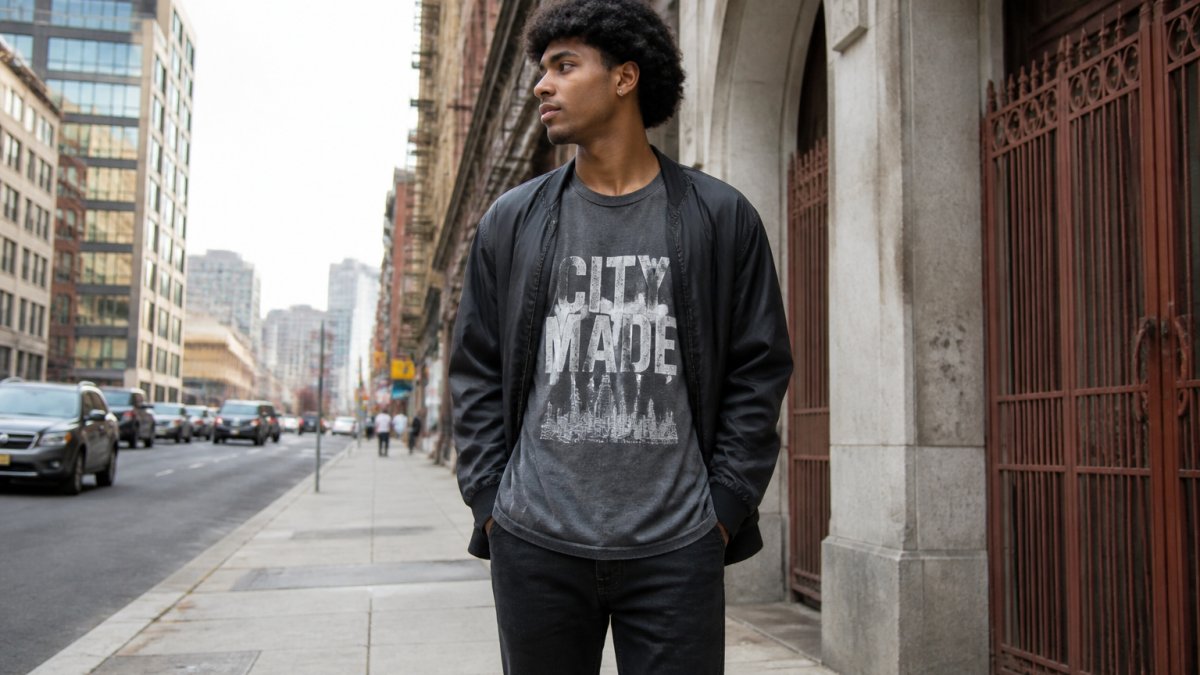
Layering, Fit, and Restraint
Fit comes first. Too tight looks like a costume; too loose swallows the graphic. Aim for a relaxed, boxy fit that lets the message breathe.
Layering adds control: a plain jacket or overshirt frames the graphic, tones down the volume, and lets you cover the message when the setting calls for it.
Restraint is the third piece:
- One graphic, one message. No competing prints.
- Neutral bottoms. Dark denim, black trousers, or clean chinos.
- Minimal accessories. Let the shirt be the loudest thing you wear.
The NYC Peace Snow-Washed Tee at $40.00 pairs a bold peace graphic with a washed, vintage fade and 100% cotton construction.

Balancing Commentary With Comfort, Dress Codes, and Safety
A message only works if you can actually wear the outfit. Comfort, dress codes, and safety set the boundaries, so decide before you buy or wear a piece which context it is for.
Comfort: The Confidence Test
Comfort is the delivery system for the message. If a piece itches, pinches, or restricts movement, you will fidget, and fidgeting reads as uncertainty. A few concrete checks:
- Fabric weight and breathability. Heavy cotton or wool blends trap heat; look for breathable knits or open weaves if you will be indoors or active.
- Range of motion. Raise your arms, sit, and bend before committing. A boxy tee that binds at the shoulder turns every gesture into an apology.
- Seam and label placement. Raw seams and printed labels can chafe over a long day; check the interior finish on pieces you will wear often.
A useful rule: if you would not wear the piece on a day when you have to be at your sharpest, it is a costume, not a statement piece.
Dress Codes: Read the Room Before You Wear the Room
Dress codes are the hardest limit because they vary by setting and are often enforced informally. Most workplaces fall into a few practical categories:
- Strict professional or uniformed settings. Slogans, logos, and political messaging are usually restricted. Expression moves to color, cut, and small details.
- Business casual. Graphic tees are often out; a plain tee under a blazer, a subtle pin, or a colored accessory can carry a message without text.
- Creative or casual workplaces. More latitude, but client-facing days still reward restraint.
A simple decision rule: if the message would distract from the work being done in the room, move it to an accessory or save it for off-duty. Minimalist fashion tips for professional settings show how to tone down expressive pieces for dress codes. That is message discipline, not surrender, a pin, a patch on a bag, or a colored ribbon can say the same thing as a shirt without triggering a dress-code conversation.
Safety: When a Statement Becomes a Hazard
Safety is the limit that gets ignored most often. Loose straps, dangling hardware, long drawstrings, and heavy layers can catch on machinery, bike chains, doors, or crowded transit.
A statement piece should never put you at risk. If a garment fails the safety check, retire it for that context and wear it elsewhere. The message can wait; the injury cannot.
A Quick Context Checklist
Before you wear a message-bearing outfit, run four questions:
- Where am I going, and what are the written and unwritten rules?
- Can I move, sit, and work in this for the length of the day?
- Is there anything that could catch, snag, or restrict me?
- Do I have a neutral layer to cover the message if the room changes?
If all four answers are workable, wear it with confidence. If not, adjust the piece, not the message.
Ethical Fashion Choices: Making a Statement You Can Stand Behind
Ethical fashion choices are the backbone of credible commentary. If your outfit says you care about people and the planet, the way it was made has to match the message.
The practical question is not whether a piece is "ethical" in the abstract, but whether the claim on your chest is backed by how it was made and how you wear it.
- Construction as a proxy for care. Reinforced seams, consistent stitching, and fabric that holds its shape after washing suggest a maker who expects the garment to last. A print that cracks after a few washes undercuts any message about quality or sustainability.
- Material claims. If a piece claims recycled or organic content, look for a fiber-content label and a certification mark rather than a vague slogan. If the claim is not on the label, treat it as marketing.
- Labor signals. Few brands disclose factory conditions; when they do, it is usually on a dedicated page. Absence of information is not proof of harm, but it is a reason to ask before you make the piece the centerpiece of a values-based outfit.
Cultural References and Respectful Borrowing
Cultural references can add real depth to an outfit. They can also cross into appropriation when a symbol is taken without respect or understanding.
Use this framework before you wear a cultural symbol:
- Do you know what it means? If not, don't wear it. Research the origin, the meaning, and who uses it.
- Is it sacred or restricted? Some symbols are ceremonial or reserved for specific people. Sacred items are not decoration.
- Are you crediting the source? Respect means naming where it comes from, in conversation, in how you describe the piece, and in where you bought it.
Respectful borrowing honors a culture; appropriation erases it. The test is not whether you like the design but whether you can explain it and whether the people it belongs to would recognize your use as respectful.
Avoiding Performative or Misleading Symbolism
A symbol worn without understanding can send a message you did not intend, or worse, one that misrepresents a cause. Three common failure modes:
- The trend symbol. A slogan or motif adopted because it is popular, then dropped when it stops being fashionable. This reads as performance, not commitment.
- The stacked message. Multiple causes on one outfit dilute each one and signal that none is central.
- The action gap. Clothing that announces a value while the wearer's choices contradict it. The outfit becomes a liability rather than a statement.
The fix is alignment: choose one message you can explain, wear it consistently, and pair it with at least one concrete action, donating, volunteering, showing up, or changing a purchase habit. Clothing is a signal; action is the substance behind it.
Building a Statement Wardrobe on a Real Budget
A statement wardrobe doesn't require a big spend, just focus. A few strong pieces, well chosen, outperform a closet full of noise. Affordable luxury streetwear statement pieces let you express commentary without overspending.
Start with the pieces that carry the most message per dollar:
- One or two graphic tees with messages you actually believe
- A plain overshirt or jacket to frame and tone down
- Dark denim or black trousers that work with everything
Buy fewer, better pieces. A well-made tee you wear twice a week beats five cheap ones that fade and crack, check construction, fabric weight, and stitching before you buy.
Find Pieces That Say What You Mean
The best statement wardrobe starts with pieces that carry a message you actually believe. The NYC Peace Snow-Washed Tee is a concrete graphic tee to start with.
We build premium urban apparel for people who want their fit to say something: high-grade fabrics, iconic graphics, and snow-washed textures that celebrate local city identity, with minimalist design and a gritty modern edge.
Consider the Classic Fit Crew Neck T-Shirt, STL 314 at $36.00, a classic-fit everyday tee with a bold STL 314 graphic. Or the Black Raw Seam Paneled St. Louis 314 Boxy Tee at $42.00, with exposed-seam shoulders and a loose boxy fit.


Here is a quick way to choose:
| Your goal | Best pick | Why it works |
|---|---|---|
| Everyday message tee | Classic Fit Crew Neck STL 314 ($36) | Clean fit, bold city graphic |
| Elevated street look | Black Raw Seam Paneled Tee ($42) | Raw seams, boxy silhouette |
| Soft vintage feel | NYC Peace Snow-Washed Tee ($40) | Broken-in wash, peace graphic |
| Rugged city statement | Raw Seam Boxy Tee, The Lou 314 ($38) | Wide boxy fit, raw detailing |
Best for: Anyone building a wardrobe where the message matters as much as the fit. Skip if: You want plain basics with no graphics at all.
Frequently Asked Questions
How can clothing express social commentary without feeling forced?
Start with one clear message per outfit and let the rest of the look stay quiet. A single graphic tee paired with neutral denim and plain outerwear reads as intentional, while stacking slogans, pins, and patches at once reads as costume. Choose pieces you would wear even if the message were removed, then let the message do the work. Fit matters too: an oversized tee with drop shoulders carries a statement more naturally than a tight shirt with a loud print.
Can graphic tees and accessories communicate social values?
Yes, and they are the most accessible entry point. A city-pride graphic like the NYC Peace Snow-Washed Tee at $40 states a position on unity and local identity in one piece. Accessories do the same job with less volume: a tote, cap, or pin can carry a message into settings where a full graphic shirt would be too much. The key is picking one carrier per outfit so the message stays legible rather than scattered.
How do I wear a statement piece to work or in a formal setting?
Check your workplace dress code first, since private employers in the US can set appearance rules and many restrict political or slogan clothing in customer-facing roles. If slogans are off-limits, move the message to a smaller carrier: a pin, a patch on a bag, or a subtle graphic under a blazer. Keep the rest of the outfit conservative so the piece reads as personal style rather than a protest.
How do I avoid cultural appropriation when using cultural references in my style?
Buy from brands and makers rooted in the culture you are referencing, and avoid sacred or ceremonial items as fashion props. Ask whether the element is meant to be worn by outsiders, and if you are unsure, leave it. Credit matters too: name where a piece comes from when people ask. Respectful use usually means paying the people who created the reference, not borrowing the look while skipping the source.
Your wardrobe is already talking. The challenge is making it say what you actually mean, without the costume effect and without cutting corners on ethics or comfort. NewCity Brand helps you get there with premium fabrics, iconic graphics, and snow-washed textures that turn a fit into a statement. Get started with NewCity Brand and build a wardrobe that speaks for you.
