

Table of Contents
- Why Small Closet Organization Matters for Your Style
- Start by Decluttering and Purging Items
- Minimalist Wardrobe Essentials That Work in Any Space
- Small Closet Storage Hacks That Maximize Every Inch
- Rotating Seasonal Clothing Without Chaos
- Digital Inventory Management for Long-Term Success
- Maintaining Your Minimalist Closet: Psychology and Habits
- Frequently Asked Questions
Last Updated: September 19, 2026
Why Small Closet Organization Matters for Your Style
A small closet doesn't mean limited style, clutter does. When you can't see your clothes, you can't wear them, creating a cycle where you buy duplicates you already own.
Small closet organization using a minimalist approach works with your space, not against it. Keep only pieces that matter, arrange them for visibility, and your closet feels bigger because it functions better.
At NewCity Brand, we understand how the right wardrobe foundation transforms your daily confidence. A minimalist closet is about intention: you wear more of what you own, spend less time deciding, and feel better about your choices.
Start by Decluttering and Purging Items
Decluttering comes first. Everything else builds on this foundation.
Pull everything out. Hang items on your bed or a rack, fold others into piles. Most people discover duplicates they forgot about and rediscover pieces they love but haven't worn in months.
For each item, ask: Do I wear this regularly? Does it fit me now? Do I feel good in it? If the answer to any is no, it goes. No guilt, no "maybe someday", those pieces waste space and mental energy.
Avoid keeping clothes that don't fit, gifts worn out of obligation, trend pieces, or damaged items. The pieces that stay form your minimalist foundation: items you reach for first, that mix and match easily, feel good, and represent who you are now.
Minimalist Wardrobe Essentials That Work in Any Space
A minimalist wardrobe starts with neutral, versatile essentials: white and black t-shirts, long-sleeve white shirt, neutral sweater, dark jeans, neutral trousers, white sneakers, and neutral blazer. These pieces work together, everything coordinates.
Add accent pieces that reflect your personality. NewCity Brand's Casual Sportswear Set, ST. LOU 314 combines comfort with bold city identity. The 420GSM heavyweight cotton construction, side-seamed construction, and double-stitched ribbed cuffs deliver durability, the kind of intentional piece that earns its space in a minimalist closet.

Small Closet Storage Hacks That Maximize Every Inch
Space optimization makes small closet organization practical. You can't add square footage, but you can use what you have smarter with permanent modifications (for homeowners) or renter-friendly hacks.
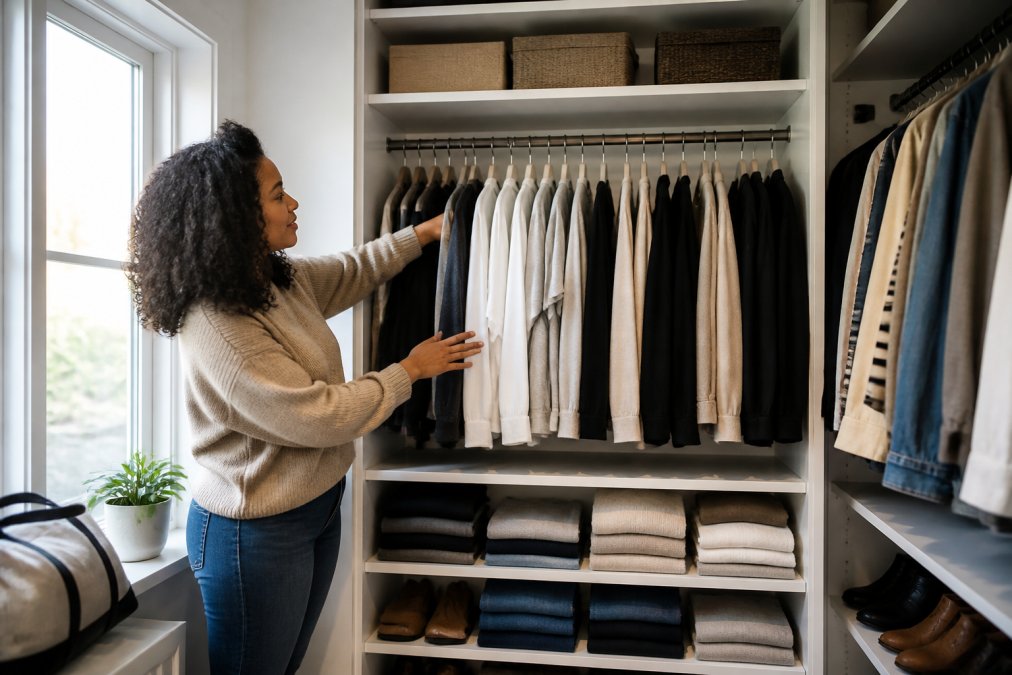
Dividing Your Closet Into Functional Zones
Zones create order: assign each area a purpose (tops, bottoms, layers, shoes). Your brain knows where to look, eliminating hunting and pulling things down.
Using Uniform Hangers for Space Efficiency
Uniform hangers eliminate visual chaos and waste. Pick thin plastic or slim wooden hangers to maximize space and fit more pieces.
Budget-Friendly DIY Modifications for Renters and Homeowners
For renters (damage-free solutions):
- Tension rods ($15-$30): Install a second hanging rod without drilling. Removes cleanly when you move.
- Over-the-door organizers ($10-$20): Add 12-20 storage slots for shoes, socks, and accessories.
- Adhesive hooks ($5-$10): Stick to walls without nails for belts, scarves, and bags.
- Stackable shelf risers ($15-$25): Double folded-item storage without installation.
- Freestanding shelving unit ($30-$50): Slim 3-shelf unit for corner dead space.
For homeowners (permanent upgrades):
- Floating shelves ($20-$40): Install 12-18 inches above the rod for folded items and accessories.
- Second hanging rod ($15-$30): Double hanging capacity for shorter items.
- Rod extender ($20-$40): Add a third hanging section in corner space.
- Pegboard ($15-$30 plus hooks): Customizable, reconfigurable storage for accessories.
Vertical Storage and Drawer Organization
Use vertical storage to maximize height: floating shelves, clear containers, and drawer dividers. File folding, standing items upright like files, maximizes visibility in small drawers without moving anything.
Rotating Seasonal Clothing Without Chaos
Seasonal rotation keeps your active closet lean. Store off-season items in labeled clear containers. When seasons change, swap them out and review pieces as you unpack, donate anything that no longer fits or appeals. Keeping only one season active dramatically increases available space and ensures everything you see is wearable right now.
Casual Sportswear Set — ST. LOU 314 →
Digital Inventory Management for Long-Term Success
A digital inventory prevents duplicate purchases. You know exactly what you own. You can plan outfits without opening your closet.
Digital inventory benefits:
- Prevents buying duplicates
- Helps you see outfit combinations
- Tracks which pieces you wear most
- Identifies gaps in your wardrobe
- Makes packing for trips easier
- Documents condition for insurance purposes
Maintaining Your Minimalist Closet: Psychology and Habits
Minimalist maintenance is a habit, not a one-time project. Small daily actions prevent your closet from sliding back into chaos. But sustaining minimalism requires understanding the psychological forces that drive clutter accumulation in the first place, and building defenses against them.
The Emotional Attachment Trap and How to Navigate It
One of the biggest threats to a minimalist closet is emotional attachment to clothing. You keep a sweater because your grandmother gave it to you, even though you never wear it. You hold onto jeans from college because they represent who you used to be. You store a dress for an event that might happen someday.
Strategies for managing emotional attachment:
- The photograph method: If an item has sentimental value but you don't wear it, photograph it. Store the photo in a digital album labeled by memory ("College," "Gifts from Mom," "Travel"). You keep the memory without keeping the physical clutter. This works especially well for inherited pieces, event dresses, or clothing from significant life periods.
- The "someday" filter: Be honest about "someday" items. Clothes you're keeping for a future size, a hypothetical event, or a version of yourself that doesn't exist yet are taking up space for your actual life. Set a deadline. If you haven't worn it in 18 months, it goes, no exceptions. This prevents your closet from becoming a storage unit for imaginary futures.
- The gratitude release: When you remove a gift you never wore, acknowledge the giver's intention without guilt. You can be grateful for the gift while recognizing it's not right for you. A simple practice: hold the item, say thank you for the thought, and release it knowing someone else will wear it. This ritual helps you let go without shame.
- The identity shift acknowledgment: Clothing represents who we were. When you remove pieces from old identities (the "party phase," the "corporate job era," the "I thought I'd be into this" hobby), you're not erasing those chapters, you're honoring your growth. Acknowledge the version of yourself that wore those clothes, then make space for who you are now.
The One-In-One-Out Rule and Purchase Resistance
The one-in-one-out rule works well. When you buy something new, something old goes. This keeps your total constant. It forces intentionality. You can't just accumulate.
Strengthen your purchase resistance:
- The 30-day rule: When you want to buy something, add it to a list. Wait 30 days. If you still want it after a month, and you have a piece to remove, buy it. This delay eliminates impulse purchases driven by emotion or marketing. Most items you think you need disappear from your mind within a week.
- The replacement question: Before buying, ask: "What am I removing to make room for this?" Make the removal decision first. If you can't identify a piece to let go, you don't have room for the new item. This creates friction that prevents mindless accumulation.
- The outfit test: Mentally wear the new item with your existing wardrobe. Can you create at least three outfits with it? Does it pair with pieces you already own? If you can't immediately see how it works with what you have, it's not a minimalist purchase, it's an orphan piece that will sit unworn.
- The cost-per-wear calculation: Divide the price by how many times you'll realistically wear it. A $100 sweater worn 50 times is $2 per wear. A $30 trendy top worn twice is $15 per wear. Higher cost-per-wear items are better investments for a minimalist wardrobe because they justify taking up space.
Weekly and Monthly Maintenance Habits
Weekly habits that maintain order:
- Hang items immediately after wearing them in their designated zone
- Return things to their zone if they've migrated
- Check for items that have fallen off hangers or shifted
- Fold sweaters or structured pieces properly to prevent stretching
- Ensure shoes are organized and accessible
Monthly review takes 30 minutes. Walk through your closet. Are items in the right zones? Is anything damaged or needs repair? Did you wear everything? If you haven't worn something in a month, consider if it deserves to stay. Track which pieces you reach for repeatedly, these are your true favorites. Notice which pieces you skip over, these are candidates for removal.
Seasonal Deep Maintenance and the Refresh Checkpoint
Seasonal maintenance happens when you rotate. This is your deep clean moment. Try on pieces as you pack them away. Do they still fit? Do you still love them? Does the condition warrant keeping them? Use this as your checkpoint before storing for months.
The Psychological Shift: From Deprivation to Abundance
The real shift is mental. Many people approach minimalism as deprivation, "I can only have 30 items." This mindset creates resentment. You feel restricted. You fantasize about buying more.
Frequently Asked Questions
How do I organize an extremely small closet without spending a lot of money?
Start by removing items you don't wear, this alone often frees up 20-30% of space. Use affordable solutions like over-the-door organizers, shelf dividers, and uniform hangers from discount retailers. Vertical storage is your best friend: stack folded items, add a second rod if possible, and use the back of the door. Many effective storage hacks work in any small closet.
What minimalist wardrobe essentials should I keep in a small closet?
Focus on pieces that mix and match: neutral base colors (black, white, gray, navy), well-fitting jeans, simple t-shirts, a blazer, and quality basics. Add 2-3 statement pieces that reflect your style, like the Brushed Fleece St. Lou 314 Hoodie for layering and streetwear appeal. The goal is pieces that work together, not items taking up space.
How do I maintain a minimalist closet long-term?
Create a one-in-one-out rule: when you buy something new, remove something old. Review your closet seasonally and be honest about what you actually wear. Track outfits digitally or in a simple note to see which pieces get worn most. This habit prevents clutter from creeping back and keeps your space intentional and functional.
What's the best way to fold and store clothes in a small closet?
Use the file-folding method: fold clothes into compact rectangles so you can see each item when stacked. Store folded items vertically in drawers or on shelves rather than stacking them horizontally, this saves space and makes items visible. For hanging items, use uniform hangers (all the same color and style) to create visual consistency and save hanging space.