

Table of Contents
- Start With Premium Streetwear Essentials, Not Trends
- Read the Fabric Before You Read the Price Tag
- Build a Streetwear Capsule Wardrobe That Actually Mixes
- How to Style Streetwear Without Looking Like You Tried Too Hard
- Streetwear Outfit Ideas You Can Rebuild From Your Own Closet
- Scale Your Budget From Entry Pieces to Investment Buys
- Care for Premium Fabrics So They Keep Their Shape
- Frequently Asked Questions
Last Updated: October 20, 2026
Start With Premium Streetwear Essentials, Not Trends
Building a premium streetwear wardrobe starts with five core pieces, not a closet full of hype drops. At NewCity Brand, we tell customers the same thing: buy the base first, then chase the statement. Trends expire. A heavyweight hoodie and a boxy tee do not.

The Five Pieces That Do Most of the Work
These five do about 80% of the work in any fit:
- A heavyweight hoodie in a neutral hue, built from dense cotton
- A boxy graphic tee with a clean, iconic print
- Tapered sweatpants or cargos with real structure
Get these right and you can style a week of outfits without repeating a look.
Read the Fabric Before You Read the Price Tag
Fabric tells you more about a garment than the tag ever will. Premium streetwear is defined by dense cotton, clean stitching, and construction that survives repeated washing.
Here is what to check on the rack or in the product photos:
- Fabric weight (in g/m²): 280g/m² and up for tees, 380g/m² and up for fleece
- Yarn count: double-fed or 20s/2 cotton signals better density
- Seams: taped necks and double-stitched cuffs resist stretching
- Pre-shrunk or not: unshrunk cotton will shrink a full size
- Dye method: reactive-dyed fabric keeps its color far longer
The Federal Trade Commission's textile labeling rules require accurate fiber content on every garment tag. Use that label as your first filter, not your last.
A common mistake is paying luxury prices for a thin, single-stitched piece. Weight and seams are the honest signals.
Build a Streetwear Capsule Wardrobe That Actually Mixes
A streetwear capsule wardrobe is a small, curated set of pieces where every item pairs with every other item. The goal is versatility, not volume. Most people overbuy and under-style; a capsule fixes that by forcing color coordination and proportion discipline from day one.
The Math Behind a Capsule
A capsule works because of combinatorial math, not minimalism for its own sake. If every top pairs with every bottom and every outer layer, the number of distinct outfits grows much faster than the number of pieces.
The rule that makes the math work: every new piece must pair with at least three pieces you already own. If it doesn't, it's a statement piece, not a capsule piece, and statement pieces should be a small minority of the closet.
A Simple 12-Piece Starting Framework
| Category | Pieces | Purpose |
|---|---|---|
| Base layers | 3 heavyweight tees | Everyday rotation |
| Mid layers | 2 hoodies | Layering and warmth |
| Bottoms | 2 sweatpants, 1 denim | Fit variety |
| Outerwear | 1 jacket | Top layer |
| Footwear | 2 sneakers | Clean and worn-in |
| Accessories | 1 cap | Finish the fit |
Stick to neutral hues for the base and let one or two statement pieces carry the personality. That is the whole method.
The Palette Rule That Makes It Mix
Pick a three-color base, typically black, off-white or cream, and one earth tone like olive, sand, or charcoal, and treat everything else as an accent.
A practical test: lay all your capsule tops on the bed and all your capsule bottoms next to them. If you can't draw a line from every top to every bottom, the palette is too wide.
What to Cut and What to Add
- Cut anything that only works with one other piece. That's a costume, not a wardrobe.
- Cut duplicate silhouettes. Two boxy tees in the same weight and color is one tee plus clutter.
- Add a second outerwear layer before you add a fourth hoodie. Outerwear changes a fit more than another mid layer does.
- Add one texture piece, snow-washed fleece, raw denim, or a garment-dyed tee, before you add another color. Texture adds depth without breaking the palette.
How the Capsule Scales
Start with the 12 pieces. Once those are working, the next additions should be upgrades, not expansions: replace the weakest tee with a heavier one, replace the worn sneakers with a cleaner pair, add one statement outerwear piece. The capsule stays roughly the same size; the average quality of each slot rises. That is how a capsule becomes premium over time instead of just bigger.
How to Style Streetwear Without Looking Like You Tried Too Hard
Effortless styling comes down to proportion, not product. Balance an oversized top with a tapered bottom, and keep the palette tight.
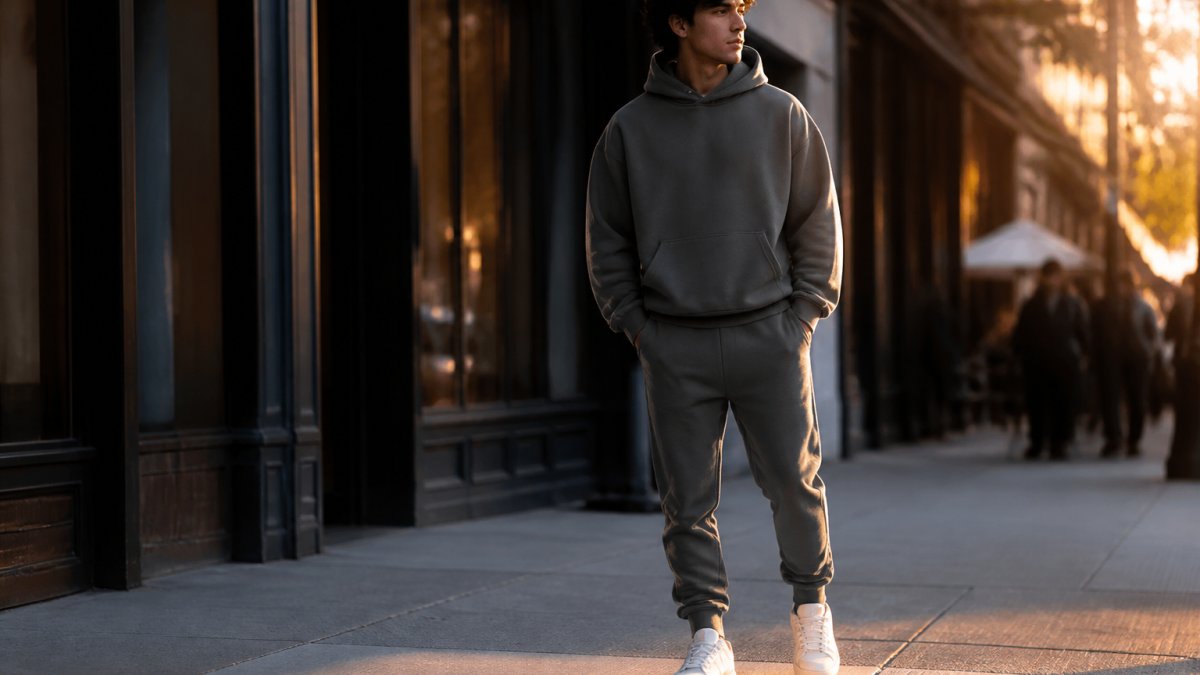
Three rules we give every customer:
- One oversized element per fit. Two baggy pieces read as sloppy.
- Match your silhouette, not your color. Boxy top, tapered leg.
- Let texture do the talking. Snow-washed fleece and raw seams add depth without loud logos.
Age is not the issue. Proportion is. A relaxed hoodie and clean denim work at 22 and at 38.
Streetwear Outfit Ideas You Can Rebuild From Your Own Closet
Great streetwear outfit ideas come from rearranging what you already own. Start with one anchor piece and build outward.
Brushed Fleece St. Lou 314 Hoodie →
Try these three builds:
- The everyday fit: heavyweight tee, tapered sweatpants, clean sneakers, cap
- The layered fit: hoodie under a jacket, dark denim, worn-in sneakers
- The statement fit: graphic tee, cargos, one bold accessory, neutral everything else
Each one uses the same capsule. You are not buying new clothes. You are recombining.

Our Brushed Fleece St. Lou 314 Hoodie pairs with the matching 314 Sweatpants for a full set, or breaks apart into two separate outfits. That is what versatility looks like in practice.
Scale Your Budget From Entry Pieces to Investment Buys
Spend where the fabric shows. Start with entry-level base layers, then scale into investment outerwear and footwear. But "spend where the fabric shows" is only useful if you know which slots reward money and which ones don't. Here is the framework we use.
The Splurge-vs-Save Map
Not every slot in a premium streetwear wardrobe rewards a higher price. Some do, some don't, and the difference is usually visible in the fabric and construction rather than the label.
- Splurge slots: outerwear, footwear, heavyweight fleece, and denim. These are the pieces where fabric weight, seam construction, and hardware quality show up immediately and where a cheap version fails visibly within a season.
- Save slots: basic tees, socks, caps, and layering pieces you'll rotate hard and replace. A well-cut heavyweight tee at a mid price beats a luxury tee at three times the price if the fabric weight is the same.
- Judgment slots: graphic tees and statement pieces. Pay for the print quality and the blank, not the logo. A cracked, plasticky print ruins a fit faster than a plain tee ever will.
The Buy Order, With Reasons
- First: tees and base layers. Fit matters most here because these sit closest to the body and set the silhouette for everything layered over them.
- Second: bottoms. They set your proportion. A great hoodie over a bad-fitting bottom still reads as a bad fit.
- Third: hoodies and fleece. Fabric weight is the honest quality signal here, and it's the easiest place to overpay for a thin garment.
- Last: outerwear and sneakers. These are the pieces you keep for years, so they reward patience and research more than speed.
This order prevents the classic mistake: a luxury jacket over a sagging tee.
A Practical Scaling Roadmap
A common pattern among people who build a premium wardrobe without overspending:
- Months 1-3: buy the base, three heavyweight tees, one pair of bottoms, one hoodie. Keep the palette tight. Total spend stays modest because these are the save slots.
- Months 4-6: upgrade the weakest base piece and add the second bottom. Start researching outerwear and footwear seriously, read fabric specs, try pieces on, and wait for the right piece rather than the first one.
- Months 7-12: make the first real investment buy, either the outerwear layer or the sneakers. This is the piece you'll wear for years, so it's worth the wait.
- Year 2 and beyond: replace, don't expand. Each season, upgrade one slot rather than adding a new category. The wardrobe stays the same size; the average quality rises.
The Cost-Per-Wear Test
Before any premium purchase, run the cost-per-wear math. Divide the price by the number of times you realistically expect to wear the piece in a year, then multiply by the years you expect it to last. A $180 hoodie worn twice a week for three years costs far less per wear than a $60 hoodie worn twice a week for one season before it sags.
For context on how much clothing production and disposal affects the planet, the Environmental Protection Agency's textile waste data tracks annual volumes. Buying fewer, better pieces is the practical answer, and the splurge-vs-save map is how you do it without turning a premium wardrobe into an overspending habit.
Care for Premium Fabrics So They Keep Their Shape
Premium fabrics fail from bad washing, not bad manufacturing. Cold water, inside out, and hang dry covers most of it.
Follow this routine:
- Wash inside out in cold water on a gentle cycle
- Use mild detergent, never bleach
- Skip the soak, rub, or wring
- Wash with like colors only
That routine keeps 100% cotton fleece from pilling and stops reactive-dyed color from fading. It is the difference between a hoodie that lasts two years and one that lasts ten.
The American Cleaning Institute's fabric care guidance confirms cold-water washing protects both fabric structure and color. Small habit, big payoff.
Frequently Asked Questions
What makes a streetwear wardrobe look premium?
Fabric weight and construction do more than logos. A heavyweight cotton hoodie at 380 to 420 g/m² holds its shape through repeated washing, while thin fabric pills and sags within a season. Fit matters just as much: a boxy silhouette with drop shoulders reads intentional, while a baggy fit that swallows your frame reads sloppy. Finish with restrained graphics and a tight color palette of neutral hues, and the whole wardrobe looks more expensive than the sum of its parts.
Which premium streetwear essentials are worth investing in?
Put your money into the pieces you wear weekly: a heavyweight hoodie, a boxy tee, tapered sweatpants, and a solid outerwear layer. These take the most wear and show quality fastest. A brushed fleece hoodie like the St. Lou 314 at $62 or a 420 g/m² Classic Boxy Hoodie at $52 gives you structure and a clean finish without a luxury markup. Save statement pieces and hype-worthy drops for later, once your base layers already work together.
How many pieces do you need for a versatile streetwear wardrobe?
Twelve to fifteen pieces covers most people. A workable streetwear capsule wardrobe runs roughly four tops (tees and hoodies), two bottoms, one outerwear layer, two pairs of sneakers, and a small set of accessories. Because every piece shares a color palette, that count produces dozens of combinations. Add one or two statement pieces per season rather than buying in bulk, and replace items as they wear out instead of stacking duplicates.
How do you balance statement pieces with streetwear basics?
Follow a rough one-to-three ratio: one loud piece against three quiet ones. If your graphic tee or snow-washed hoodie carries the visual weight, keep the pants, shoes, and accessories in neutral hues so the eye has somewhere to land. This is the core of how to style streetwear without looking overdressed. Rotate which piece plays the lead each day, and the same small wardrobe reads differently all week.
Building a wardrobe that lasts takes discipline, not a bigger budget. Most people buy too much and care for it too little. At NewCity Brand, we build pieces meant to hold their shape: high-grade cotton, snow-washed textures, and minimalist designs that celebrate your city. Start with one anchor piece, then scale. Shop now →