

Table of Contents
- How Long Does Premium Streetwear Last: Realistic Timelines
- The Fabric Weight Factor: Why GSM Matters
- How to Care for Premium Streetwear to Maximize Lifespan
- Fast Fashion vs. Premium Streetwear Durability: Where the Difference Shows
- Is Expensive Streetwear Worth the Price: Cost-Per-Wear Analysis
- Identifying Authentic Premium Quality Before You Buy
- Frequently Asked Questions
Last Updated: October 3, 2026
How Long Does Premium Streetwear Last: Realistic Timelines
Understanding how long does premium streetwear last, typically 3-7 years with proper care, depends on fabric weight, construction quality, and how often you wear it. That's a significant jump from fast fashion pieces, which typically wear out within 6-12 months. The difference comes down to material density, seam integrity, and dye stability.
At NewCity Brand, we've built our pieces around heavyweight fabrics and meticulous construction specifically to extend garment life. When you invest in premium streetwear, you're paying for fabrics that resist pilling, hold color, and maintain structure through repeated washing and wearing.
The key factor determining longevity is fabric weight, measured in grams per square meter (GSM).
Heavyweight Cotton Basics (400+ GSM)
Heavyweight cotton at 400 GSM and above is the gold standard for streetwear durability. This density creates a fabric so tightly woven that it resists pilling, fading, and fiber breakdown. A 400+ GSM hoodie or tee can realistically last 5-7 years of regular wear when cared for properly.
A 400 GSM piece packs roughly double the cotton fibers into the same square inch as a standard 200 GSM tee. When individual fibers break down, others remain to hold the garment together.
NewCity Brand's Heavyweight Sun-Faded Hoodie uses 400g/m² combed cotton with brushed fleece lining. This construction handles repeated washing and daily wear without losing its structure. The side-seamed construction and double-stitched ribbed cuffs prevent the weak points where most garments fail first.

Heavyweight pieces are stiffer initially, but soften over time as they break in, a sign of quality, not deterioration.
Mid-Weight Pieces (280-350 GSM)
Mid-weight fabrics (280-350 GSM) sit between durability and comfort. They're lighter than heavyweight pieces but still substantially thicker than fast fashion basics. A mid-weight premium tee typically lasts 3-5 years.
The Snow-Washed St. Louis "The Lou" Graphic Tee from NewCity Brand uses 285g/m² cotton, placing it in the mid-weight range. This density is ideal for graphic tees, heavy enough to resist fading and pilling, light enough to feel natural against skin.
Mid-weight pieces require slightly more careful handling than heavyweight ones. They're less forgiving of aggressive washing or high heat. But with standard care, they'll outlast fast fashion by years.
The Fabric Weight Factor: Why GSM Matters
GSM directly determines how long premium streetwear lasts. It's the single most predictive factor for garment lifespan. Here's why it matters more than brand name or price tag.
GSM is weight per square meter of fabric. A 400 GSM cotton tee weighs roughly twice as much as a 200 GSM tee because of fiber density, not padding.
A 400 GSM fabric can lose 10-15% of its fibers and still function. A 150 GSM fast fashion piece can't absorb that loss, it pills, tears, or becomes transparent.
Tensile strength scales with GSM. A 400 GSM cotton can withstand roughly 4 times the pulling force of a 100 GSM piece, which matters during normal wear and movement.
Fiber degradation happens to all cotton, but density slows it down. In lightweight fabric, degradation quickly becomes visible, the piece thins, becomes translucent, or loses shape. In heavyweight fabric, you can lose significant fiber content and the piece still looks solid.
Check the care label on any premium piece. It specifies fabric weight for a reason. Brands that use 400+ GSM are signaling confidence in durability.
How to Care for Premium Streetwear to Maximize Lifespan
Proper care extends the life of premium streetwear by years. The difference between a piece lasting 3 years and 7 years comes down to washing, storage, and repair habits.
Washing Without Damage
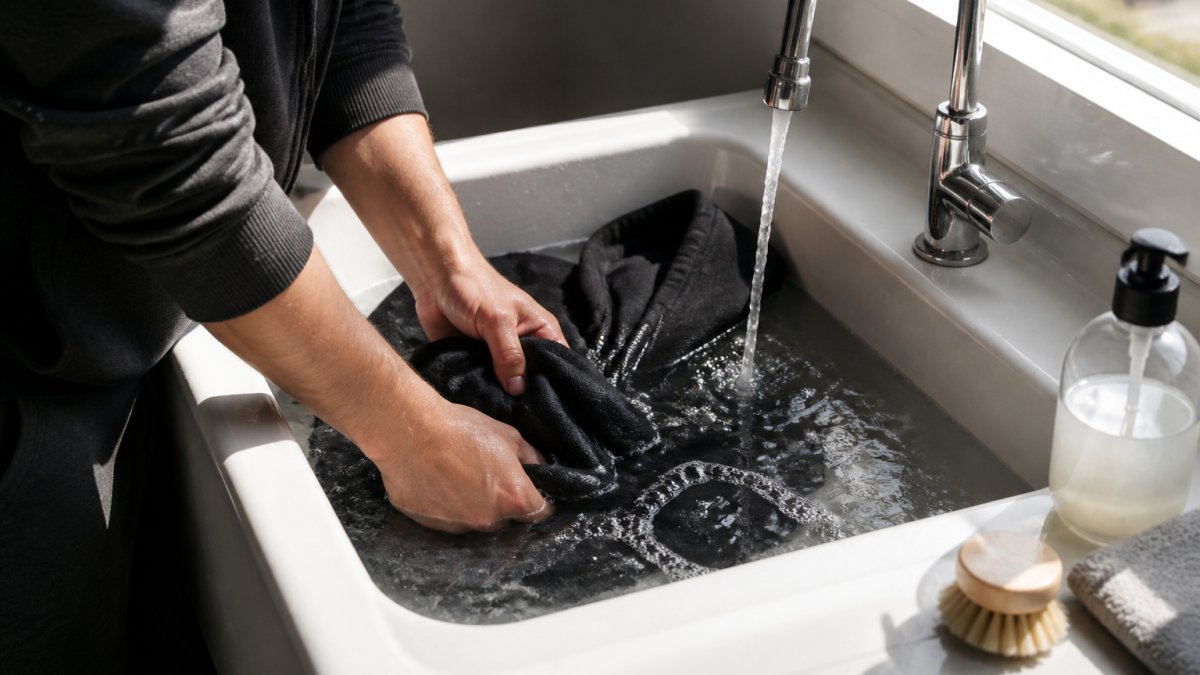
Wash in cold water on a gentle cycle with mild detergent, inside out. Hot water accelerates fiber breakdown and causes dyes to bleed. Inside-out washing reduces friction, protecting graphics and surface finishes.
Never soak pieces or use bleach. A 30-minute gentle wash is sufficient; bleach breaks down cotton structure.
Washing like-colored garments together prevents dye transfer. Darker pieces shed dye, especially in the first 1-2 washes. Washing them separately protects lighter pieces from permanent staining and reduces the dye load in the water, which means less re-deposition of loose dyes onto the garment itself.
Use mild detergent without enzymes or optical brighteners, which damage fibers and cause yellowing. Neutral detergents preserve color and fiber integrity. Use sparingly; excess detergent requires more rinsing and stresses fibers.
Drying and Storage
Air dry only; tumble drying accelerates fiber breakdown. Hang dry in shade to prevent UV fading and fiber weakening.
Store pieces flat or folded on shelves, not hangers, which stretch shoulder seams. Keep in a cool, dry place away from direct light, with 40-50% relative humidity.
Pilling: Prevention and Removal
Pilling is a natural response to friction, not a sign of poor quality. Premium fabrics pill less because tightly woven, high-GSM fabric has fewer loose fibers.
Prevent pilling by washing inside out and avoiding rough surfaces. Remove pills gently with a fabric comb or pilling stone, stroking in one direction. Don't pull with your fingers, which damages surrounding fibers.
Common Repairs: Extending Life Beyond Normal Wear
Most premium streetwear fails at predictable points. Addressing these issues early prevents small problems from becoming unwearable.
Loose Threads and Small Holes
Use a needle and matching thread. For small holes, use a ladder stitch to pull the hole closed from inside. For loose threads, tie them off or weave them back into the fabric.
Stretched Collar or Cuffs
Soak the stretched area in hot water for 10-15 minutes, then lay flat to dry. The elastic will contract as it dries. For severe stretching, carefully restitch the binding with a tighter seam.
Seam Separation
Restitch early using a backstitch along the original line. For long or critical seams, take to a tailor for professional repair.
Fading and Discoloration
For light stains, soak in cold water with mild detergent for 30 minutes, then gently rub. For set-in stains, consult a professional dry cleaner. Avoid bleach. Many embrace fading as intentional character.
Pilling on Large Areas
Use a fabric comb or electric pilling remover with light pressure and short strokes; aggressive scrubbing thins the fabric.
Heavyweight Sun‑Faded Hoodie — STL 314 →
Regular maintenance can add 2-3 years to a premium piece's life. A $60 hoodie lasting 7 years instead of 4 saves money and reduces waste.
Fast Fashion vs. Premium Streetwear Durability: Where the Difference Shows
The durability gap becomes obvious after 6 months of regular wear. Here's where the difference becomes measurable by usage patterns.
Lifespan by Wear Frequency
Fast fashion pieces (150-200 GSM) typically last:
- Light wear (1-2 times per week): 12-18 months before visible degradation
- Regular wear (3-5 times per week): 6-9 months before seams fail or graphics crack
- Heavy wear (daily): 3-4 months before unwearable condition
Premium streetwear (350+ GSM) typically lasts:
- Light wear (1-2 times per week): 5-7 years with minimal fading
- Regular wear (3-5 times per week): 3-5 years before noticeable wear
- Heavy wear (daily): 2-3 years before requiring repair
Why the Gap Exists: Fiber Degradation Rates
Fast fashion uses loosely woven cotton or blends. Each wash removes 5-8% of surface fibers; after 15-20 washes, the fabric thins and pills aggressively. Graphics crack because cheap inks don't bond with low-density fabric.
Premium streetwear uses tightly woven, combed cotton at 350+ GSM with 1-2% fiber loss per wash. Reactive dyes chemically bond with fibers, fading gradually over years rather than cracking within months.
Seam Failure: The Breaking Point
Fast fashion uses single-stitched seams with 2-3 threads; seams unravel quickly when threads break. Premium pieces use double-stitched seams with 4-6 threads, distributing stress so losing one or two threads doesn't compromise the seam.
Colorfastness: The Visible Marker
After 10 washes:
- Fast fashion pieces show 20-30% color loss, especially in darker shades
- Premium pieces show 5-10% color loss
After 30 washes:
- Fast fashion pieces are noticeably faded, often with uneven color loss
- Premium pieces retain 75-85% of original color
After 50+ washes:
- Fast fashion pieces are often unwearable due to fading, pilling, and shape loss
- Premium pieces still look intentional, with a "lived-in" patina rather than deterioration
The Cost Reality
A $15 fast fashion tee worn 20 times = $0.75 per wear before it's unwearable.
A $50 premium tee worn 150 times = $0.33 per wear, plus 30-40% resale value recovery.
The premium piece costs less per wear despite the higher upfront price, and it can be worn for years rather than months.
Is Expensive Streetwear Worth the Price: Cost-Per-Wear Analysis
Cost-per-wear divides purchase price by actual wears. A $40 NewCity Brand tee worn 100 times costs $0.40 per wear versus $0.75 per wear for a $15 fast fashion tee worn 20 times.
Premium streetwear makes financial sense if you:
- Wear pieces regularly (at least weekly)
- Keep items for 2+ years
- Actually care for them properly
- Choose designs you won't tire of quickly
Premium streetwear doesn't make sense if you:
- Buy pieces you wear once or twice
- Chase trends aggressively
- Neglect garment care
- Prefer variety over longevity
The cost-per-wear calculation also ignores resale value. Premium pieces hold 30-50% of their original value on the secondhand market. A $60 hoodie worn for 3 years might resell for $20-30, bringing the true cost down significantly.
Fast fashion pieces have almost no resale value. A $20 tee is worth $2-3 used, if anyone wants it at all.
Identifying Authentic Premium Quality Before You Buy
Not all expensive streetwear is actually premium. Price alone doesn't guarantee durability. Here's how to verify quality before you commit.
Check the fabric weight. Look for GSM listed on the product page or care label.
Examine the seam construction. Premium pieces use double-stitched or flatlock seams. Fast fashion uses single-stitched seams.
Read the fiber content. 100% combed cotton is the gold standard. Cotton blends with polyester are cheaper to produce and less durable.
Verify the printing method. Screen-printed graphics on premium pieces should feel smooth and integrated with the fabric, not raised or plasticky.
Look for binding and reinforcement details. Premium pieces use taped neck bindings and reinforced shoulder seams. These details are visible in product photos and prevent stretching and tearing.
Check the brand's care instructions. Brands confident in durability provide detailed care guidance.
NewCity Brand lists specific care protocols because we stand behind lifespan. Our pieces are designed to improve with age, not deteriorate.
Premium streetwear that lasts 5-7 years represents genuine value if you're willing to invest upfront and care for pieces properly.
Frequently Asked Questions
How long should high-quality premium streetwear last with proper care?
Premium streetwear built from heavyweight cotton (400+ GSM) typically lasts 3-5 years with regular wear and proper maintenance. Pieces with strong seam construction, double-stitched ribbing, and quality dyes hold up longer. Mid-weight pieces (280-350 GSM) generally last 2-3 years. The key is washing inside-out in cold water with neutral detergent, air-drying, and avoiding bleach or high heat. Cost-per-wear improves dramatically when garments last multiple years versus fast fashion alternatives that deteriorate within months.
What factors determine the durability of premium streetwear?
Durability depends on fabric weight (GSM), fiber type (combed cotton vs. standard), seam construction (double-stitched vs. single), and dye quality (reactive-dyed holds color longer). Heavyweight pieces with side-seamed construction and taped binding resist pilling and seam failure. Natural fiber blends outperform synthetic-heavy blends for longevity. Proper care also matters: washing gently, air-drying, and avoiding direct sunlight prevents fiber degradation and colorfastness loss. Premium streetwear brands invest in these details; fast fashion cuts corners on all of them.
Does price always correlate with how long premium streetwear lasts?
Price correlates with durability when the premium reflects better materials and construction, but not always. A $64 heavyweight hoodie with 400g/m² fabric weight and double-flatlock seaming will outlast a $100 piece made from thin, loosely-woven cotton. Examine fabric weight, fiber composition, and seam details rather than price alone. Brands that use combed cotton, reactive dyes, and side-seamed construction justify higher costs. Conversely, some premium-priced streetwear relies on hype over construction quality. Verify the specs before assuming cost equals longevity.
How does washing impact the lifespan of graphic tees and printed streetwear?
Frequent washing degrades screen prints and dyes if done incorrectly. Wash inside-out in cold water on a gentle cycle with mild detergent to protect graphics and colorfastness. Avoid bleach, soaking, and high heat (max 30°C or 86°F). Air-dry and skip direct sunlight, which fades both natural and reactive dyes. Slight bleeding may occur on the first wash, so wash like-colored garments together. Graphic tees last 2-3 years with proper care; careless washing can cut that to 6-12 months. The investment in premium construction means nothing if washing destroys the finish.