

Table of Contents
- Why Distressed T-Shirts Anchor the Rugged Urban Look
- How to Style an Oversized T-Shirt Without Drowning in It
- Distressed Graphic Tee Outfit Ideas for Every Season
- What to Wear With a Graphic T-Shirt: Bottoms and Footwear
- Layering Distressed Layers: Grunge, Punk, and Streetwear Influences
- DIY Distressing and Care: Keep the Edge Without Ruining the Tee
- Conclusion
- Frequently Asked Questions
Last Updated: October 21, 2026
Why Distressed T-Shirts Anchor the Rugged Urban Look
Styling distressed t-shirts for a rugged urban look starts with one idea: wear that looks lived-in, not thrown on.
That distinction matters. A tee that looks beat-up by accident reads sloppy. A tee that looks broken-in on purpose reads confident.
Here's what most guides miss: the distressing is only half the outfit. Below, we'll show you exactly how to build complete outfits around a distressed tee, from summer to winter.

How to Style an Oversized T-Shirt Without Drowning in It
How to style an oversized T-shirt comes down to balance. An oversized tee works when one part of the fit is big and the rest stays clean. When everything is baggy, the body disappears.
Proportion Rules for Boxy and Drop-Shoulder Cuts
- Boxy cut: keep bottoms fitted or straight-leg, never wide
- Drop shoulders: let the seam sit past your shoulder, but stop before mid-bicep
- Loose fit: pair with a slimmer bottom to keep a clean line
A common mistake is sizing up twice. One size up gives a relaxed fit. Two sizes up swallows your frame.
Tucking, Half-Tucking, and Hem Length
The half-tuck is the fastest fix for an oversized silhouette. Tuck the front hem only, leave the back loose. It shows your waistline and keeps the relaxed shape.
- Full tuck: works with high-waisted jeans and a belt
- Half-tuck: best for boxy tees and drop shoulders
- No tuck: works when the hem hits mid-fly, not mid-thigh
Distressed Graphic Tee Outfit Ideas for Every Season
Distressed graphic tee outfit ideas work year-round because the tee is the base layer, not the whole look. Change the outer layer and the shoes, and the same tee carries you from July to January.
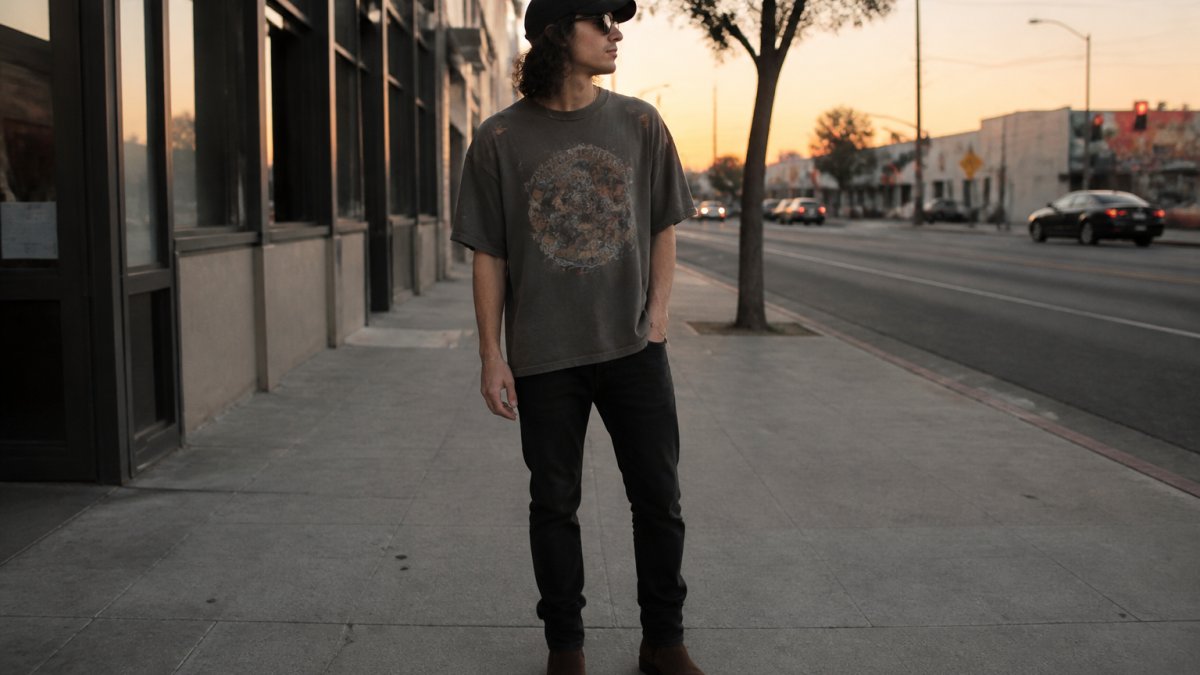
Summer Formulas: Shorts, Caps, and Open Layers
- Formula 1: distressed graphic tee + denim shorts + low-top sneakers + cap
- Formula 2: oversized tee + open short-sleeve button-up + sunglasses
- Formula 3: washed black tee + light shorts + brown boots for evening
Keep summer colors moody. Washed black, faded gray, and sun-bleached tones beat bright prints.
Cold-Weather Formulas: Oversized Jackets and Distressed Layers
- Formula 4: distressed tee + oversized denim jacket + dark jeans + boots
- Formula 5: graphic tee + long flannel + camouflage pants + statement boots
- Formula 6: tee + oversized bomber + beanie + ripped jeans
The rule for cold weather: one oversized layer, not two. An oversized jacket over an oversized tee flattens your shape.
What to Wear With a Graphic T-Shirt: Bottoms and Footwear
What to wear with a graphic T-shirt comes down to two choices: bottoms that ground the print and shoes that finish the edge.
Jeans, Camouflage Pants, and Statement Boots
- Dark straight jeans: the safest pairing for any graphic print
- Ripped jeans: adds texture, but keep the rips to one area
- Camouflage pants: bold, so keep the tee graphic simple
| Bottom | Best For | Footwear Pairing |
|---|---|---|
| Dark straight jeans | Everyday fits | Brown boots or low-tops |
| Ripped jeans | Grunge and punk looks | Statement boots |
| Camouflage pants | Streetwear edge | Black boots |
| Denim shorts | Summer outfits | Sneakers and a cap |
Layering Distressed Layers: Grunge, Punk, and Streetwear Influences
Layering is where distressed layers earn their place. Grunge, punk, and post-punk all built their looks on worn tees under open jackets, and streetwear carried that habit forward. But most guides stop at naming the subculture. The useful part is the mechanics: what to layer, in what order, and how to keep the silhouette from collapsing.
The Layering Order That Works
Build from the skin out. Each layer should be thinner than the one over it, and each should be visible at a different point.
- Base: the distressed tee. Keep it the thinnest layer.
- Mid: an open shirt, flannel, or lightweight overshirt. This is where most of the visual texture lives.
- Outer: a jacket or coat. This carries the silhouette.
- Accessory layer: cap, beanie, belt, or bag to finish the edge.
A common mistake is putting the heaviest layer closest to the body. That traps heat, flattens the tee, and hides the distressing you paid for.
Fabric Weight Contrast: The Engine of the Look
The throughline of every subculture below is contrast. A soft, faded tee against a stiff jacket creates the tension that makes the look work. Match weights deliberately:
- Lightweight tee (under 200 g/m²) + heavy canvas or denim jacket: maximum contrast, best for grunge and streetwear.
- Midweight tee (200-260 g/m²) + flannel or overshirt: balanced, best for everyday fall wear.
- Heavyweight tee (280 g/m² and up) + lightweight bomber or coach jacket: keeps the outfit from feeling top-heavy.
If both layers are heavy, the outfit reads as bulky. If both are light, it reads as flat. One heavy, one light is the reliable formula.
Length Ratios: How to Avoid the Layered Blob
Layering fails when every hem lands at the same height. Stagger them:
- Tee hem at the waist or mid-fly.
- Mid layer hem 2-4 inches below the tee hem, or clearly above it if cropped.
- Outer layer hem at the hip or longer.
A visible 2-4 inch difference between layers gives the eye a line to follow. When all three hems align, the body disappears.
Subculture Formulas, Rebuilt With Specifics
- Grunge: faded band tee + open flannel (midweight, not quilted) + ripped dark jeans + boots. Leave the flannel unbuttoned; button only the bottom button if you want shape.
- Punk: ripped graphic tee + studded belt + dark straight denim + statement boots. Keep the jacket cropped or fitted so the belt stays visible.
- Post-punk: monochrome tee + long coat (wool or heavy cotton) + clean boots. The coat is the only oversized piece; everything under it stays slim.
Seasonal Adjustments
The same layering logic works year-round if you swap the mid layer:
Sun‑Faded Distressed Tee — Bronx 718 →
- Summer: tee + open short-sleeve button-up, worn unbuttoned. Skip the outer layer.
- Fall: tee + flannel or overshirt + boots.
- Winter: tee + mid layer + insulated jacket. Keep the tee visible at the neckline and hem so the distressing still reads.
If the outer layer covers the entire tee, the distressed detail is wasted. Leave at least one distressed edge, hem, collar, or sleeve, exposed.
DIY Distressing and Care: Keep the Edge Without Ruining the Tee
Most styling guides stop at inspiration. This section covers the part competitors skip: how to distress a tee on purpose, how far you can push a fabric before it fails, and how to keep intentional wear from turning into a rag after five washes.
Tools and a Safe Distressing Workflow
You do not need a studio. A basic kit covers most jobs:
- Chalk or a fabric marker to mark wear zones before cutting
- Sharp fabric scissors (not kitchen shears) for clean snips
- Fine-grit sandpaper (around 120-220 grit) for softening edges
Work in this order: mark, cut small, sand, wash, then reassess. Fabric frays further in the wash, so a small cut becomes a bigger one after one cycle. Cut no more than you are willing to lose.
Placement: Where Distressing Reads as Intentional
Placement matters more than the amount of damage. High-wear zones read as lived-in; random holes read as accidental.
- Hem: the safest starting point. A frayed hem sits higher after washing, so cut 1/4 to 1/2 inch above your target length.
- Collar: a lightly sanded collar edge adds age without weakening the neckline seam.
- Sleeve hems: good for a subtle roll-and-fray look.
A common pattern among people who distress their own tees: they overwork the front and ignore the back. The back is what people see when you walk away, so a light sanding on the lower back hem balances the look.
Fabric Limits: What Each Material Can Take
Not every tee distresses well. Match the technique to the fabric.
- 100% combed cotton (midweight, around 200-260 g/m²): the most forgiving. Holds a frayed hem and takes sanding well.
- Heavyweight cotton (280 g/m² and up): resists fraying. Cuts stay clean but may look too crisp; sand edges longer.
- Cotton-poly blends: fray less and can pill. Use sanding over cutting.
If the care label lists spandex, elastane, or a high polyester percentage, sand instead of cut.
Care and Repair: Preserve the Distressing
Distressed garments need slightly different care than intact ones. The goal is to slow further damage without sealing the look.
- Wash inside out in cold water on a gentle cycle with mild detergent.
- Use a mesh laundry bag for tees with open hems or sanded edges to prevent snags.
- Skip the dryer or tumble on low heat only. Heat accelerates fraying and shrinks cotton.
- Hang dry away from direct sunlight to protect the dye and the graphic print.
When to Stop
Stop distressing when the hem loses structure, when a seam starts to pull, or when you can see light through the fabric at a wear point. At that stage, the tee has moved from styled to worn out.
For more on fabric care and dye stability, the American Cleaning Institute fabric care guidance covers wash temperature and detergent basics.
Conclusion
Building a rugged urban look takes intention, not a bigger budget. Start with one distressed tee that fits right, then add bottoms, boots, and layers that balance it.
Our Sun-Faded Distressed Tee comes in city graphics like Bronx 718, Houston 713, Chicago 312, and South Central 323, each at $40.00. Every piece uses heavyweight combed cotton, a boxy drop-shoulder cut, and a snow-washed fade that looks broken-in from day one.

Frequently Asked Questions
What should you wear with a distressed graphic T-shirt?
Start with a relaxed bottom: straight-leg jeans, camouflage pants, or dark cargos keep the focus on the tee. Add brown boots or statement boots for weight at the bottom, then finish with a cap and sunglasses. Keep the color palette moody, washed black, charcoal, olive, and faded indigo, so the graphic print stays the loudest element in the outfit. If the tee is boxy, balance it with a slimmer leg; if the pants are baggy, keep the tee closer to the body.
How do you style an oversized distressed T-shirt without looking sloppy?
Treat the oversized silhouette as the base and control everything else. A drop-shoulder tee with a loose fit works best when the hem hits mid-fly, so a half-tuck or a slight front tuck gives shape without fighting the cut. Pair it with a straight or tapered bottom rather than another wide piece, and use structured footwear like boots to ground the look. Rolling the sleeves once and keeping the neckline clean also stops an oversized T-shirt from reading as an accident.
How can you keep a distressed outfit looking intentional rather than messy?
Limit the distressing to one or two pieces. If the tee has a distressed hem and washed fade, keep the jeans clean and the jacket intact. Choose a dark color palette so the wear reads as designed rather than worn out, and make sure the fit is deliberate: oversized on top, controlled on the bottom. NewCity Brand's Sun-Faded Distressed Tees, at $40.00, are built with a pre-shrunk 260g/m² combed cotton body, so the shape holds after washing and the distressing stays subtle.
Do oversized shirts work for streetwear outfits?
Yes, oversized shirts are a core streetwear piece, but the fit has to be intentional. Look for drop shoulders and a boxy body rather than a shirt that is simply two sizes too big. Balance the volume with a straight-leg jean or camouflage pant and a chunky boot. In cooler weather, an oversized jacket over an oversized tee works if the layers differ in length, so the hem of the tee shows below the jacket.