

Table of Contents
- What a Minimalist Wardrobe Actually Means (And What It Doesn't)
- How to Declutter Clothes Without Second-Guessing Every Piece
- Minimalist Wardrobe Essentials for Men
- Your Capsule Wardrobe Checklist: Step by Step
- Quality Over Quantity: How to Evaluate What You Buy
- Psychological Barriers to Minimalism (And How to Get Past Them)
- Maintaining Your Minimalist Wardrobe Long-Term
- Conclusion
Last Updated: August 13, 2026
What a Minimalist Wardrobe Actually Means (And What It Doesn't)
A minimalist wardrobe is a curated collection of versatile, high-quality clothing pieces that work together intentionally, eliminating the excess that clutters your closet and your decision-making. The goal isn't to own as few items as possible. It's to own exactly what you need, nothing more.
Here's what most guides get wrong: minimalism isn't about deprivation or a uniform of gray t-shirts. It's a framework for intentional living that applies directly to how you dress. The capsule wardrobe system, which sits at the heart of this approach, is built on the idea that fewer, better pieces create more outfit options than a closet stuffed with impulse buys.
At NewCity Brand, we work at the intersection of minimalist design and bold city identity, so we understand that paring down doesn't mean boring. A well-built minimalist wardrobe expresses who you are more clearly than a cluttered one ever could.
This guide walks you through the full process: decluttering your current closet, building a capsule collection from scratch, evaluating quality, and maintaining what you build over time.
How to Declutter Clothes Without Second-Guessing Every Piece
The biggest mistake people make when decluttering is treating every item as a separate decision. That's how you end up three hours in, holding a shirt you haven't worn in two years, convincing yourself you might wear it next summer.
A structured wardrobe audit changes that entirely.
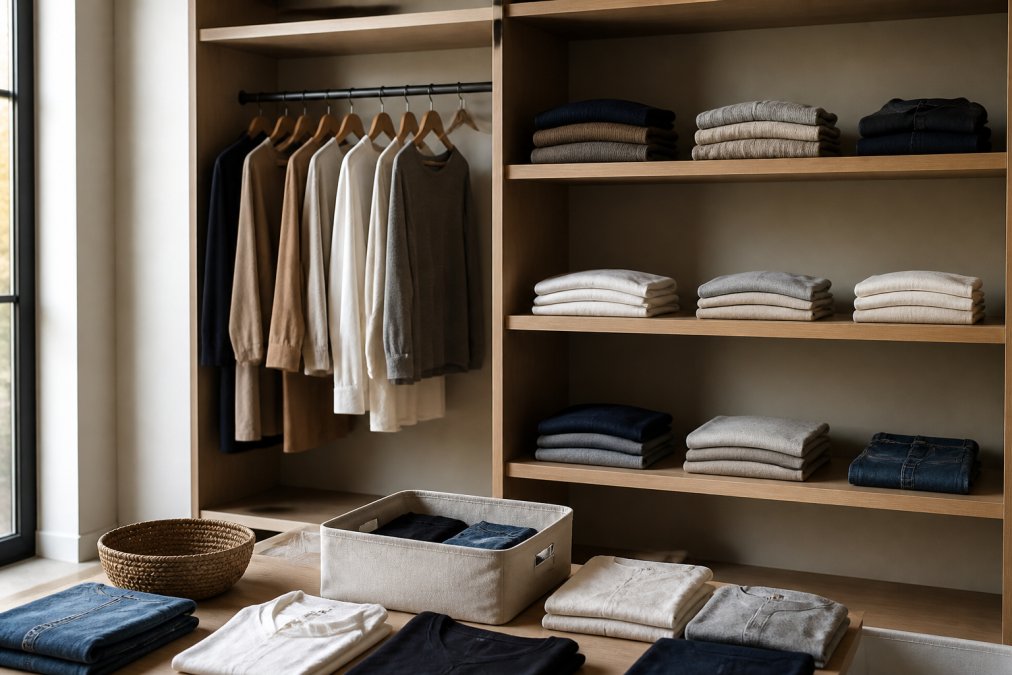
The Wardrobe Audit: A Room-by-Room Clothing Inventory
A clothing inventory is a complete, systematic review of every garment you own, evaluated against clear criteria before any decisions are made. Pull everything out. Every drawer, every shelf, every bag shoved in the back of the closet. Pile it all in one place.
Then run each piece through three questions:
- Have I worn this in the last 12 months? If no, the burden of proof is on keeping it.
- Does it fit my body right now, not the body I plan to have? Clothes that don't fit today take up real space.
- Does it work with at least three other pieces I already own? Versatility is the core test for a capsule wardrobe.
Items that fail all three go. Items that pass all three stay. Items in the middle go into a 30-day box: if you don't reach for them in a month, they leave.
This process works because it removes emotion from individual decisions and replaces it with a system.
Sustainable Disposal: Where Unwanted Clothes Actually Go
Decluttering responsibly matters. According to the EPA's overview of textile waste and sustainable disposal options, textiles are one of the most recoverable waste streams, yet many items end up in landfills unnecessarily.
Better options for unwanted clothes:
- Donate to local shelters, mutual aid networks, or community clothing swaps
- Sell through resale platforms or consignment shops for items still in good condition
- Recycle through brand take-back programs or textile recycling bins for worn-out pieces
- Swap with friends or organized swap events for variety without new purchases
Slow fashion starts with how you exit items, not just how you enter them. Sustainable disposal is part of the minimalist wardrobe mindset, not an afterthought.
Minimalist Wardrobe Essentials for Men
Building a minimalist wardrobe starts with identifying the core pieces that form the foundation of everything else. For men, the capsule essentials follow a clear hierarchy: base layers first, then mid-layers, then outerwear and footwear.
Core Layers and Base Pieces Worth Investing In
Core layers are the items you'll wear most often, so fabric quality and fit matter more here than anywhere else. A common mistake is spending more on statement pieces and cutting corners on basics. The basics are what people actually see every day.
The foundation of a men's capsule wardrobe typically includes:
- 3-4 quality crewneck or V-neck t-shirts in white, black, and one neutral
- 2 well-fitting button-down shirts, one casual and one that can dress up
- 1-2 crewneck sweatshirts or mid-layer knits
- 2 pairs of dark denim or chinos that fit cleanly
- 1 versatile jacket or overshirt that works across seasons
- 1 pair of clean, minimal white or black sneakers
- 1 pair of leather or leather-look shoes for occasions that call for it
That's roughly 12-16 pieces as a starting point. Many practitioners of the capsule system find this range workable across most lifestyles and professional contexts.
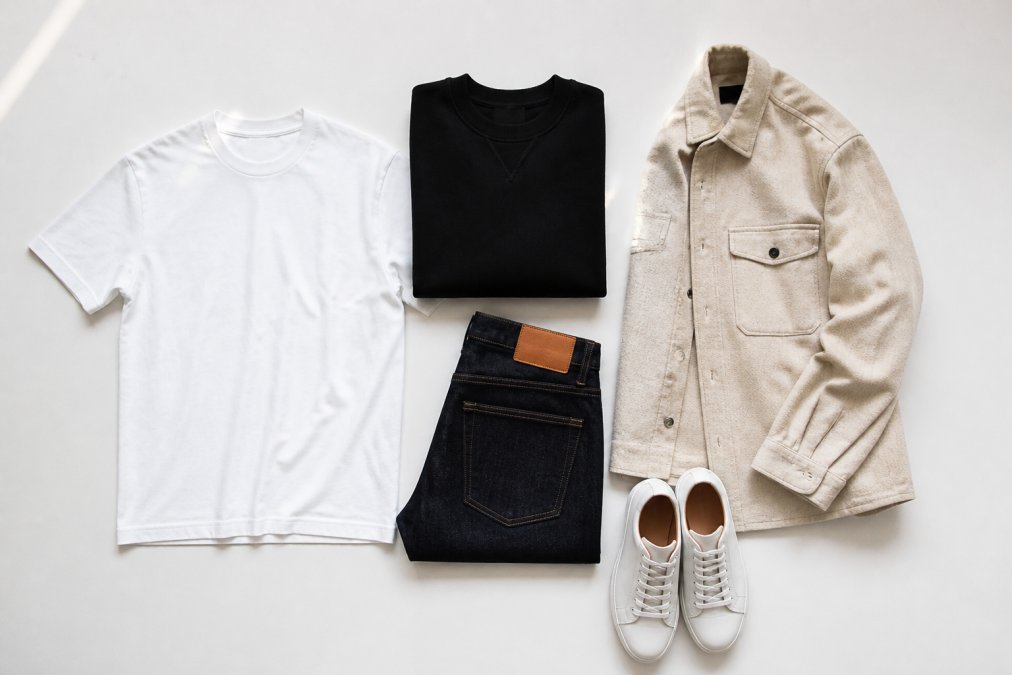
Building a Neutral Palette That Works With Everything
A neutral palette means your pieces mix and match without effort. Navy, white, black, gray, camel, and olive form the core. Add one or two accent colors if your style calls for it, but keep them consistent across pieces so they still combine cleanly.
The real advantage of a neutral palette isn't aesthetic. It's decision fatigue reduction. When everything works with everything else, getting dressed takes seconds instead of minutes.
Your Capsule Wardrobe Checklist: Step by Step
A capsule wardrobe checklist gives you a repeatable system instead of a one-time purge. Here's how to build yours:
| Step | Action | Frequency |
|---|---|---|
| 1. Audit | Pull out and evaluate every item | Twice per year |
| 2. Purge | Remove anything that fails the 3-question test | After every audit |
| 3. Identify gaps | List what's missing from your capsule essentials | After purging |
| 4. Shop intentionally | Buy only what's on your gap list | As needed |
| 5. Rotate | Swap seasonal pieces in and out | Spring and fall |
| 6. Maintain | Clean, repair, and store pieces properly | Ongoing |
Capsule Planning by Season and Lifestyle
Seasonal rotation is how a small wardrobe stays functional year-round. Store off-season pieces properly, and bring them back when the weather shifts. This keeps your active closet tight without sacrificing practicality.
Lifestyle matters just as much as season. A remote worker and a creative director who needs to be client-ready have different capsule needs. The framework stays the same; the specific pieces shift.
For professional dress codes, the capsule approach still applies: anchor around two or three well-cut suits or blazers, rotate shirts and trousers underneath, and keep footwear to two or three pairs that cover all your professional contexts. Minimalism for specific professional dress codes isn't about wearing less. It's about wearing better, more consistently.
Quality Over Quantity: How to Evaluate What You Buy
Quality over quantity is the most repeated advice in minimalist fashion and the most ignored in practice. Here's a concrete way to evaluate it.
Cost-per-wear is the most useful metric: divide the price of an item by the number of times you realistically expect to wear it. A well-made crewneck you reach for three times a week has a much lower cost-per-wear than a cheap alternative you replace every six months.
When evaluating a piece before purchase, check:
- Fabric composition. Natural fibers like cotton, wool, and linen generally last longer and age better than synthetic blends.
- Seam construction. Turn the item inside out. Reinforced seams and clean finishing indicate durability.
- Fit as-is. If it doesn't fit well off the rack, factor in whether tailoring makes sense at that price point.
- Versatility. Ask whether the piece works in at least three different outfits in your existing wardrobe.
According to the Sustainable Apparel Coalition's Higg Index framework for measuring garment quality and environmental impact, fabric durability and construction quality are among the strongest predictors of a garment's useful lifespan. Buying fewer, better pieces isn't just a style choice. It's a measurably more sustainable one.
Psychological Barriers to Minimalism (And How to Get Past Them)
Most wardrobe audits stall not because of logistics but because of psychology. The thing nobody tells you about building a minimalist wardrobe is that the clothes are rarely the real obstacle.
Three patterns show up repeatedly:
Sunk cost attachment. "I spent a lot on this, so I should keep it." Sunk costs are gone regardless of whether you keep the item. The only relevant question is whether it serves you now.
Identity anchoring. Clothes from a past version of yourself, a job you no longer have, a lifestyle you no longer live. These are worth examining honestly. Keeping them doesn't preserve who you were; it just crowds out who you are now.
Scarcity thinking. "What if I need this someday?" This is the most common reason people keep items they never wear. A practical test: if you got rid of it and actually needed something like it, how hard would it be to replace? For most items, the answer is "not very."
As documented in research on decision fatigue and choice overload from Princeton Neuroscience Institute, having fewer choices actually improves decision quality. A smaller, more deliberate wardrobe isn't a constraint. It's a cognitive advantage.
Getting past these barriers requires naming them directly. Once you can identify which pattern is driving hesitation on a specific item, the decision usually becomes straightforward.
Maintaining Your Minimalist Wardrobe Long-Term
Building the wardrobe is the easy part. Maintaining it is where most people fall off.
The core problem is that the closet doesn't stay minimal on its own. Without a system, it drifts back toward clutter through small, incremental additions: a sale item here, a gift there, a piece bought for an occasion that never repeats.
The One-In One-Out Rule and Seasonal Rotation
The one-in one-out rule is the simplest maintenance system: every time a new item enters the wardrobe, one item leaves. This keeps the total count stable without requiring a full audit every time you shop.
Seasonal rotation reinforces this. Twice a year, at the shift between warm and cold weather, pull out the off-season storage and run a quick assessment. Items that didn't get worn in their season get evaluated for removal before they go back into storage.
Wardrobe maintenance also means caring for what you own. Proper washing, storage, and occasional repair extend the life of quality pieces significantly. A well-maintained wool sweater or well-constructed denim jacket can last years longer than a neglected one.
Outfit repeating is a feature of a minimalist wardrobe, not a flaw. The goal is a signature style, a consistent visual identity that people associate with you, not a different look every day. Many style-conscious people find that a defined aesthetic becomes more distinctive over time, not less.
NewCity Brand's approach to minimalist design with premium construction is built for exactly this kind of long-term wardrobe strategy: pieces with clean lines, high-grade fabrics, and a gritty modern aesthetic that stays relevant across seasons rather than chasing trends.
For further guidance on sustainable wardrobe care and slow fashion principles, Good On You's guide to sustainable fashion and ethical clothing care offers practical, regularly updated advice on extending garment life and making more intentional choices.
Building a minimalist wardrobe is straightforward in theory and genuinely difficult in practice, mostly because the psychological friction is real and the marketing pressure to keep buying never stops. The system outlined here, audit, purge, build from core layers, evaluate quality, and maintain with discipline, gives you a repeatable framework rather than a one-time reset. NewCity Brand crafts pieces designed to anchor exactly this kind of wardrobe: minimalist in construction, bold in identity, built from high-grade fabrics that hold up over time. Shop now and find the pieces worth keeping.
Frequently Asked Questions
How many items should be in a minimalist wardrobe?
Most capsule wardrobe frameworks suggest 30 to 50 total pieces, including tops, bottoms, outerwear, and shoes. The exact number depends on your lifestyle, climate, and how often you do laundry. The goal isn't hitting a specific count, it's making sure every piece you own gets regular wear. If items sit untouched for months, they're candidates to remove regardless of how many pieces you have total.
What is the best color palette for a minimalist wardrobe?
A neutral palette built around blacks, whites, grays, and navy gives you the most outfit combinations from the fewest pieces. Earth tones like tan, olive, and camel layer in naturally. Once your core is set, you can add one or two accent colors that reflect your personal style. The point isn't to wear only gray, it's to choose colors that mix easily so every piece in your minimalist wardrobe works with everything else.
What is the 90-90 rule for decluttering clothes?
The 90-90 rule asks two questions about any item: Have you worn it in the last 90 days? If not, will you wear it in the next 90 days? If the answer to both is no, that piece is a strong candidate for removal. It's a practical filter that cuts through sentimental attachment and forces an honest look at what actually gets worn versus what just occupies closet space.
How do you start a minimalist wardrobe without spending money?
Start by doing a full wardrobe audit of what you already own. Most people discover they already have solid capsule essentials buried under rarely worn pieces. Pull out everything, identify your most-worn items, and build your capsule from those. Declutter the rest through donation or resale. Only buy new pieces after you've identified genuine gaps, not before. You can build a strong minimalist wardrobe almost entirely from what you already have.
This article was written using GrandRanker